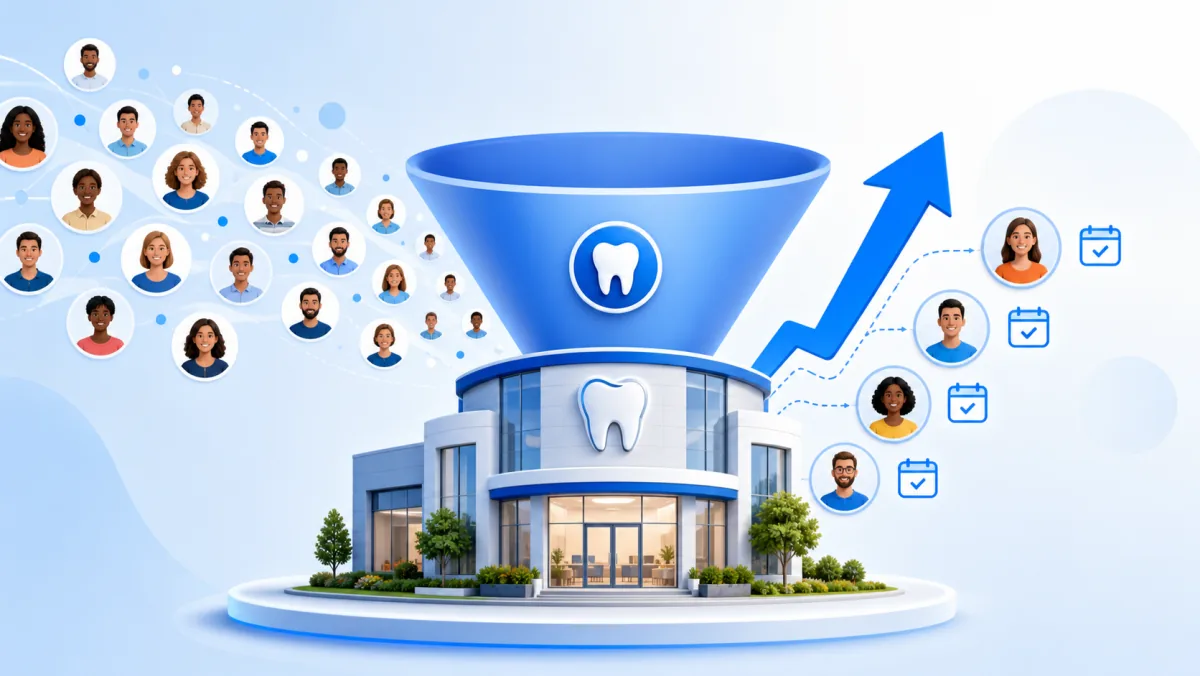
The fastest way to attract patients to a dental clinic is not to “run ads” — it is to catch the moment someone is already searching for treatment and carry that query through to a booking. A search such as “implant price Tashkent” or “dentist near me” usually signals a next-step need: a trustworthy clinic, a convenient location and a clear way to make contact. Time to visit varies by city, service, clinic and response speed, so measure confirmed bookings rather than assume a fixed window. Below is how to build patient flow channel by channel, measurably.
Short answer
Dental patient flow has three connected parts: capturing high-intent searches, maintaining a complete and trustworthy business profile, and responding quickly while recording each enquiry in a CRM. Fix the profile, reviews and measurement first; then test one service and scale from confirmed-booking data.
How does a dental patient search?
Searches split into three intent groups, each needing a different channel:
- Urgent / high intent: “emergency dentist”, “toothache at night”, “dental clinic near me”. This person wants to book today — speed and visibility win here (Google Ads + Maps).
- Researching / comparing: “implant price”, “zirconia vs porcelain”, “how long orthodontics takes”. No clinic chosen yet — trust and information win (SEO content + reviews).
- Brand / verification: “clinic X reviews”, searching the name directly. Reputation and site quality decide here.
The key mistake is squeezing all three intents into one campaign and one message. Showing a “smile design” ad to someone in acute pain simply burns budget.
Urgent intent: the patient picks the earliest slot, not the clinic
Someone in acute pain does not compare technologies or read the “about us” page. Three things decide it: whether the clinic appears at the top for the pain query, whether the phone number is one tap away, and whether a human picks up right now. Long copy about equipment only gets in the way here — a short promise of “we can see you today” plus a clear address is what converts.
Research intent: the decision stretches over weeks
This patient is choosing between three or four clinics, and explanation beats discount. A page that shows a price range, treatment stages and the dentist removes the real fear — an unpredictable final bill. Such a person almost never books on the first visit to the site, so you bring them back with remarketing and content rather than pushing “call now”.
Brand intent: the last check before booking
Before dialling, the patient searches the clinic name and reads what people say about it. This is exactly where already-paid traffic leaks away: if the newest review is two years old and the site has no real photo of the practice, the person leaves for a competitor whose click cost the clinic nothing.
Which 5 channels actually bring patients?
Sustainable patient flow comes not from one channel but from a system where channels reinforce each other:
- 1. Google Ads (harvesting high intent). Separate campaigns by service: implants, orthodontics, pediatric, emergency, cosmetic. Each service gets its own ad group, message and landing section. Negative keywords (“free”, “job”, “student”) are updated weekly, or budget leaks to irrelevant clicks.
- 2. Local SEO + Google/2GIS Maps. Most “dentist near me” searches convert from the map. A complete profile (photos, hours, services, phone) and steady reviews bring bookings even without ads.
- 3. Instagram / Telegram (trust and recall). Before/after (ethical and consented), meet-the-doctor, patient experience. The goal is not direct sales but that a hesitant person remembers and trusts the clinic.
- 4. Reviews and reputation (social proof). Dentistry is about trust. Google and 2GIS ratings often matter more than price. Review collection must be systematic.
- 5. Website + online booking. All channels flow here. A slow, non-mobile site with an unclear booking step throws away the clicks you paid for.
Which dental marketing numbers can you trust?
One “industry average” is not a reliable target for every Central Asian clinic. Treatment type, city, language, clinical capacity, price and response speed all change the outcome. Replace unverified acquisition benchmarks with the clinic's own measured data.
The World Health Organization estimates that oral diseases affect nearly 3.7 billion people worldwide. That shows the scale of need; it does not predict one clinic's advertising conversion. Use four clinic-level measures for decisions:
| Metric | Calculation | Decision |
|---|---|---|
| Confirmed-booking cost | Advertising spend ÷ confirmed bookings | Compares channels by the same outcome. |
| Booking conversion | Confirmed bookings ÷ qualified enquiries | Shows landing-page and reception performance. |
| Attendance rate | Attended visits ÷ confirmed bookings | Reveals reminder and communication gaps. |
| Treatment conversion | Patients starting treatment ÷ attended visits | Connects advertising to real revenue. |
How do you turn a click into a booking?
In dental advertising a click is not the result; the booking is. The bridge has three parts:
- Landing page: doctor, location/photos, license, reviews and one clear action (call / WhatsApp / book). Send traffic to the section for the searched service, not a generic homepage.
- Fast response: who answers, and how fast? There is a conversion gap between replying in 5 minutes and the next day.
- CRM and follow-up: every call, WhatsApp and form is logged — who asked what, callback needed, did the patient show up. Advertising without CRM is water in a leaking bucket.
Separately, no-shows are the silent cost of clinics; automated reminders (SMS/Telegram) reduce them noticeably.
Landing page: one service, one page
The page an ad points to must answer exactly the question that was typed into search. Sending an implant query to a generic homepage forces the patient to hunt for the right section, and most of that traffic never reaches the form. The working minimum: a dentist with a photo, the address, the licence, reviews, and one action visible in the first screen.
Response speed matters more than ad copy
The gap between replying in five minutes and replying the next day cannot be closed by any amount of campaign optimisation. Every clinic therefore needs a named owner for enquiries during working hours and a clear script outside them: an automatic Telegram or WhatsApp reply that records a callback time beats silence.
CRM and follow-up: where half the enquiries disappear
A patient who asked about price and did not book is not lost — they simply have not reached a decision. Without their question written down in a CRM, follow-up is impossible and the clinic pays for that same person a second time through advertising. A simple table of date, channel, service, question asked and callback date lifts bookings noticeably without raising the budget.
Why does one strategy not work across all of Central Asia?
Uzbekistan, Kazakhstan, Kyrgyzstan, Tajikistan and Turkmenistan are not one advertising market. Even when patients seek the same treatment, their search language, city terms, preferred contact channel, payment expectations and trust signals differ. Instead of opening one campaign across five countries, test each country, city, language and service separately.
| Market | First test | Localisation check |
|---|---|---|
| Uzbekistan | Start with Tashkent; test Samarkand and Bukhara separately. | Keep Uzbek and Russian search terms in separate keyword groups. |
| Kazakhstan | Do not combine Almaty, Astana and Shymkent in one campaign. | Adapt Russian and Kazakh pages for local price, doctor and location expectations. |
| Kyrgyzstan | Measure confirmed-booking cost separately in Bishkek and Osh. | Choose phone, messaging or forms from actual conversion data. |
| Tajikistan | Test Dushanbe and Khujand with separate landing pages. | Use real Tajik and Russian search language rather than literal translation. |
| Turkmenistan | Verify channel availability and campaign feasibility for Ashgabat first. | Confirm local requirements and platform restrictions before launch. |
Decision rule: allocate budget by confirmed-booking cost and treatment conversion, not by country population.
What are the trust and policy risks in health ads?
Health advertising is sensitive. “Best”, “guaranteed”, “painless certain result” are hard-to-prove claims carrying both platform-policy risk (Google/Meta health rules vary by country) and trust risk. The right language relies not on exaggeration but on process, specialty, location and a consultation call. Before/after use requires patient consent.
What should you measure, and what should you ignore?
The first month’s goal is not maximum sales but clean data: which service brings a cheaper qualified lead, which channel leads to a booking, whether calls/WhatsApp/forms are tracked separately, which hours and devices produce more bookings. After 30 days, budget shifts to the campaigns with the lowest cost per booking.
The metrics you must track
The minimum set is short: cost per booking by service, the share of enquiries that reach the chair, first-response time, and the no-show rate. Those four numbers answer the question the owner actually cares about — what one genuinely attended patient costs, and at which point in the chain the rest are lost.
The metrics that mislead
Impressions, reach, followers and raw clicks look convincing in a report but say nothing about revenue. A clinic with growing reach and falling bookings is an ordinary situation, not a paradox. An advertising report should open with the line “how many bookings and at what cost”, not with an impressions chart.
How do you keep a patient after the first visit?
Most clinics count marketing only at the entrance and ignore the second half entirely — bringing back the patient who already came. Yet the cheapest revenue hides exactly here: someone who has already sat in that chair and trusts the dentist needs neither a click nor an ad.
Why a repeat visit is cheaper than a new patient
Acquiring a new patient costs a clinic a three-figure sum; inviting an existing one costs a single message. Bringing even thirty of every hundred treated patients back for a check-up fills part of the schedule without a cent of ad spend and simultaneously pulls down the clinic-wide average acquisition cost.
How the reminder cycle works
The working pattern is simple: a reminder the day before the appointment (against no-shows), a contact a few days after treatment (checking recovery and creating a natural moment to ask for a review), and a check-up invitation six months later. In Uzbekistan this cycle lives naturally in Telegram and WhatsApp rather than email, which this segment barely reads.
How to turn a patient into a referral source
Referrals convert better than any other source, but they rarely happen on their own. The request for a review has to land while the patient is still pleased with the result — right after treatment ends, not a month later. Every such review works twice: it convinces the next patient and lifts the clinic profile in local search.
What are the most common mistakes?
- Merging all services into one campaign and one message.
- Not maintaining a negative-keyword list (budget leak).
- Sending ads to the homepage instead of a service landing page.
- Answering leads late or not logging them (no CRM).
- Ignoring reviews and the map profile.
What should you do in the first 90 days?
Patient flow is not built in a day, but 90 days is enough to see which channel works. The plan below runs from the cheapest work to the most expensive.
| Period | Focus | Concrete work | Metric |
|---|---|---|---|
| 0–30 days | Foundation + data | Complete Google/2GIS profile, start review collection and call logging, small-budget Ads test | First-response time, enquiries per channel |
| 30–60 days | Optimisation | Shift budget to the winning service, improve the landing page, clean negatives, add reminders | Cost per booking, conversion, no-shows |
| 60–90 days | Scaling | Separate campaign for implants/orthodontics, CRM, referral flow | Booking→treatment, case value |
The goal of the first 30 days is not sales but clean data: which service produces cheaper qualified enquiries, what hours calls arrive, which device books. Increasing budget before answering these only scales the mistake.
(Source: 101digital's own dental campaign delivery experience — the 0–30 / 30–60 / 60–90 day stages)
How should you plan the budget?
Do not copy a starting budget from another country's average. Set a measurable test for each city and service; increase spend only after you have confirmed-booking and treatment-conversion data.
- Fix the profile, reviews, measurement and landing-page basics.
- Test one or two high-intent services in one city.
- Record calls, messages and forms in one CRM.
- After four weeks, compare confirmed-booking cost rather than click cost.
Which service is more profitable to focus on?
The most expensive mistake is marketing every service as if it were equally valuable. A check-up and an implant case differ enormously in both revenue and chair time, yet budget is usually allocated without accounting for it. The result: the clinic looks busy while revenue stands still.
Measure per chair hour, not per patient
The right metric is not "how much did this patient spend" but "how much revenue did an hour of chair time produce". A forty-minute check-up and an implant case spread over three visits give very different results per hour. A clinic that skips this calculation keeps advertising its most requested but least profitable service.
Why high-value services are marketed differently
Implants, orthodontics and cosmetic dentistry usually require more research and stronger trust evidence. Instead of assuming a fixed acquisition cost, measure confirmed bookings and treatment starts for each service. Build the message around clear information about the clinician, process, suitability and first consultation rather than pressure.
Which service to start with
For a budget-constrained clinic the best start is the service that produces the highest revenue per chair hour and is genuinely searched for in your area. When those two do not overlap, search volume wins: advertising a service nobody searches for yields nothing regardless of margin.
(Source: 2026 acquisition-cost benchmarks for high-value dental services — implants, orthodontics and cosmetic work)
How do you analyse competitors?
Competitor analysis sounds like agency work but takes an afternoon. The goal is not to copy but to see where you are behind and where a gap exists. Three places are enough.
Map competition
Search "dental clinic" in your district and note the first five: review count, average rating, date of the latest review, number of photos. This table usually reveals an uncomfortable but clear truth — the clinic on top is there not because its dentists are better but because it manages its profile better.
Ad competition
Run the same searches and see who advertises, which services they lead with and where the ads point. If a competitor sends traffic to their homepage, that is your opening: a service-specific landing page converts better on the same query.
Content and price transparency
Do competitors publish prices, introduce their dentists, explain the treatment process? In Uzbekistan these blocks are empty at most clinics — which makes them open to you: a clinic that honestly shows a price range and process easily wins the patient still in the research phase.
How can a small clinic compete with a chain?
A small clinic cannot outspend chains on advertising — and does not need to. It has three advantages that translate directly into digital.
First, speed: a small team can answer an enquiry within minutes, while large structures often take hours. Second, personality: content featuring the dentist personally builds more trust than faceless corporate communication. Third, focus: a clinic that goes deep on one district and two or three services outranks broad competitors on those searches.
The practical strategy: rather than spreading budget, concentrate on one district and one high-value service, overtake competitors on review count, and turn response speed into a competitive advantage.
Real case studies
Our Client Results in This Area
Meta Ads and Google Ads management for an Uzbek container terminal and warehousing operator. Work has just begun.
Digital marketing for a Tashkent-based IVF and women's health center
Google Ads management for Turkey's sole authorized representative for West Africa cargo tracking certificates
Checklist
- Is the campaign structure built by service?
- Are calls and WhatsApp tracked separately?
- Is the Google/2GIS profile complete and collecting reviews?
- Does the landing show doctor, location, license, reviews?
- Are CRM and a no-show reminder in place?
Note: this article is not medical or legal advice. Healthcare advertising must be checked against local regulations, platform policies and internal clinic approvals.
Sources and verification note
- World Health Organization — Oral health fact sheet
- Google Business Profile — Tips to improve local ranking
- Google Ads — Healthcare and medicines policy
Google explains that local results are mainly based on relevance, distance and prominence. For healthcare advertising, verify the target country's law and platform rules before launch. Sources checked on 4 August 2026.
Related reading
How 101digital handles this work
Measure which channel brings confirmed bookings for your Central Asian dental clinic. We review advertising, local SEO, landing pages and CRM by country, city, language and service, then build the first test plan.
→ Explore performance marketing or learn about marketing consulting.