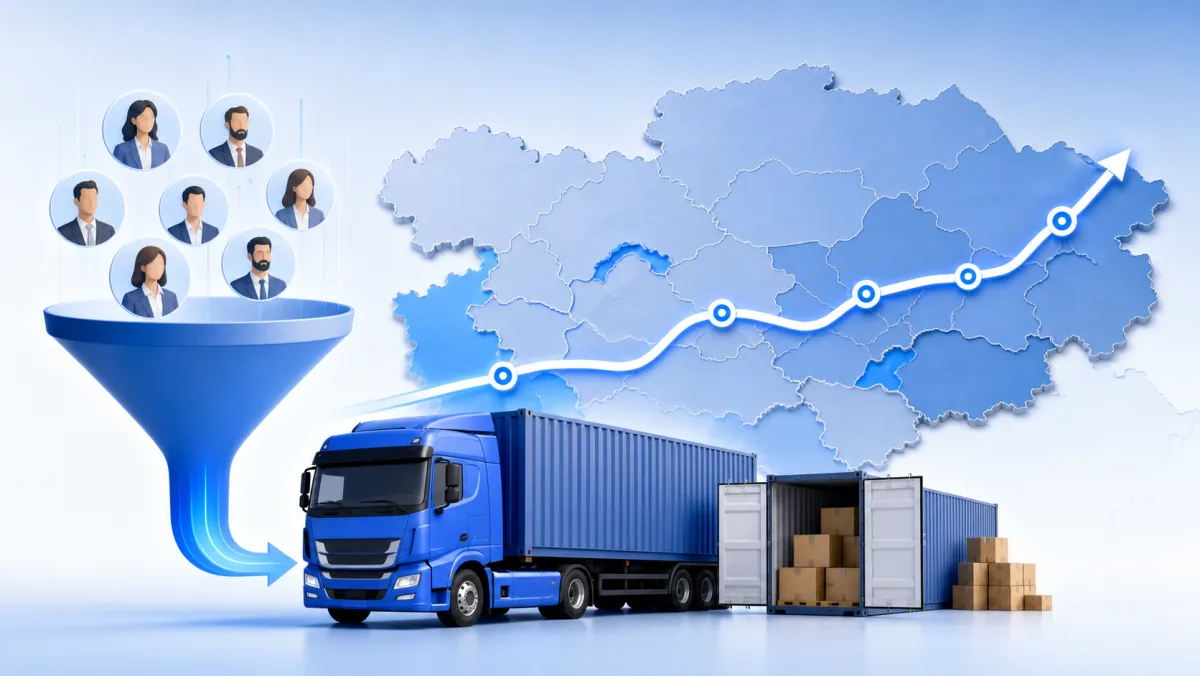
In logistics, clients do not appear because you "started advertising" — they appear through an RFQ invitation, and the real task is turning a one-off load board shipment into contract work. This is a different game from B2C: there is no single decision maker, the purchase takes weeks, and the first job is almost always a small test lane. Below is the client acquisition system, funnel, KPIs and first-90-day plan for a logistics company, with real figures from the Uzbekistan market.
Short answer
Logistics clients come from three sources: the load board fills today's capacity, search (SEO + Google Ads) brings companies actively looking for a carrier, and direct sales produce contract work. The critical step is converting a one-off board load into your own client database. What you measure is not lead count but the RFQ invitation rate.
Who is the logistics client and who decides?
A "client" in freight is not one person. Inside a shipper, the transport decision is usually the combined judgement of three people, and each looks at something different. Both your advertising and your quote have to address all three.
| Role | What they look at | What rules you out |
|---|---|---|
| Logistics / operations manager | Lane coverage, transit time, equipment fit | "They don't run our lane" |
| Procurement / finance | Rate, payment terms, paperwork quality | "Expensive" or "documents are a problem" |
| Owner / managing director | Reliability, reputation, risk | "I don't know them, I won't take the risk" |
| Warehouse / floor | Loading discipline, driver communication | Generates complaints, ends the contract |
The practical way to use this table is to prepare three separate proof sets rather than one brochure. The pack for the operations manager holds the lane list and equipment types; the one for finance holds rate logic and document turnaround; the one for the owner holds references and insurance details. If all three are on the table in the same meeting, the other side decides which one matters — you simply arrive ready.
Three different worries, three different proofs
You show the operations manager a lane list, finance a rate logic and clean paperwork, and the owner references and an on-time delivery record. A single "quality service" message convinces none of them, because it answers none of their questions.
What is happening in Uzbekistan's logistics market?
The market is growing, and for marketing that is good news: demand is rising while digital competition remains weak. The figures give a clear picture.
(Source: Gazeta.uz and Spot.uz — 2026 transit and freight turnover data; Uzbekistan State Programme 2022-2026 targets)
| Indicator | Value | What it means |
|---|---|---|
| Transit freight (2025) | 15.3 mn tonnes, +54% vs 2021 | Transit has become a serious revenue line |
| Freight turnover, H1 2026 | +43% | Demand is rising |
| Transit, H1 2026 | +35% | International business is expanding |
| Middle Corridor share | 12% → 28% | New route, new client type |
| State programme target (2022-26) | Cut freight cost by up to 30%, double the container share | Price pressure; differentiation is mandatory |
| The sector's main problem | Heavy concentration in Tashkent, weak regional infrastructure | Regional visibility = white space |
One marketing decision follows from these numbers: position yourself on the growing line. If transit and container volumes are rising, those two areas belong in the most visible place on your site and in your quote. A company speaking in general terms about "domestic haulage" stays invisible exactly where the growth is — and competition there is far weaker than on saturated local lanes.
Translating the numbers into marketing
While transit and container volumes grow, everyone introduces themselves with the same three words: "reliable, fast, competitive". Yet it is clear what is actually growing — international and container freight. A company that talks about specific lanes and transit times stands out from ten competitors speaking in generalities.
Where do clients come from: channel comparison
In freight, channels are not alternatives to each other — they sit at different points of the funnel. The table shows what each one delivers and what it does not.
| Channel | What it delivers | Weakness | Role |
|---|---|---|---|
| Load board | Today's load, quick capacity fill | One-off, price competition, the client isn't yours | Cash flow |
| Search (SEO + Ads) | A company actively looking for a carrier | Low volume, very high intent | Qualified demand |
| Direct sales | The shipper you chose to target | Labour intensive, slow | Contract work |
| Referral / network | Highest conversion | Does not scale | Baseline |
| Telegram | Fast communication, industry groups | Not enough on its own for corporate buyers | Communication layer |
| International network / forwarders | Transit and export freight | Requires language and process | High margin |
In a healthy company these channels work together: the board funds today, search brings qualified demand, direct sales build the contract. A company leaning on one channel is exposed the day that channel changes its rules.
Is a load board enough?
In the region, load boards are the carrier's natural starting point; ATI.SU remains the most widely used platform across Uzbekistan, Russia, Kazakhstan and other CIS countries, with an interface available in Uzbek among other languages. It can be used free with limited functionality, while full access requires a monthly subscription.
The structural problem: the client isn't yours
A load from the board is a one-off, and the selection criterion is almost always price. Ten carriers see the same load; the cheapest wins. That fills capacity but produces no margin — and more importantly, the shipper remembers the platform, not you.
The right use: the board is a tool, the contract is the goal
You do not have to abandon the board; you have to try to turn every load it brings into a client you will work with again. That takes three steps: haul it flawlessly, make direct contact after delivery ("we run this lane regularly — how often do you have volume?"), and record that company in your own database. Ending load-board dependency is the most concrete way to grow margin in freight.
How does the B2B logistics sales funnel work?
Selling does not happen in one step. In international measurements the median B2B sales cycle sits around 84 days, and in freight it runs longer still. The typical pattern: a shipper invites you to quote, gives you one test lane, watches your service for a quarter, and only then opens up volume.
(Source: 2026 B2B sales cycle benchmarks — median cycle length and freight buying pattern)
| # | Stage | What happens |
|---|---|---|
| 1 | Target list | Shipper type is chosen: manufacturer, exporter, e-commerce |
| 2 | First contact | Email opens the door, the phone runs the deal |
| 3 | Qualifying call | Lane, volume, frequency, incumbent carrier |
| 4 | Quote / RFQ | Rate + lane coverage + transit time |
| 5 | Test load | One lane, small volume — fail here and nothing follows |
| 6 | Watching quarter | On-time delivery and paperwork accuracy are measured |
| 7 | Contract | Volume opens, rate is fixed |
| 8 | Expansion | New lane, new division, new country |
Marketing owns stages 1-4; operations owns 5-8. Where that split is blurred, the company says "advertising isn't working" — when in fact the deal was lost on the test load.
Which KPIs should you measure?
"How many leads did we get" is a misleading question in freight: one RFQ invitation is worth more than ten form fills. Measurement is built around funnel transitions.
| Transition | KPI | Why this one |
|---|---|---|
| List → contact | Right-person reach rate | Logistics manager or procurement? |
| Contact → call | Conversation rate | Are we speaking in lanes and volumes? |
| Call → RFQ | RFQ invitation rate | Marketing's real output |
| RFQ → test load | Quote win rate | Are we losing on rate or on coverage? |
| Test → contract | On-time delivery %, damage %, paperwork accuracy | Operations does the selling here |
| Contract → expansion | Lanes per client | Most B2B revenue lives here |
| Overall | Cost per closed contract, cycle length | Cost per lead alone is meaningless |
Read the table top to bottom and stop at the first row that falls below target. Intervene only in that transition; a company changing five things at once never learns which one worked. Next month, measure the same row again: if it has improved, move down one row; if not, the intervention was the wrong choice.
The key idea: an operations metric is a marketing asset
On-time delivery share, damage rate and paperwork accuracy are not only operational indicators — they are what wins the tender. The sentence "97% on-time across 1,400 shipments in the last 12 months" is more persuasive than any ad copy. A company that does not measure that number does not know its own strongest argument.
What should you do in the first 90 days?
For a company starting from zero, or invisible online, a realistic programme looks like this. The order matters: proof first, visibility second, scale last.
| Period | Focus | What to do | What to measure |
|---|---|---|---|
| Days 0-30 | Proof and basics | Lane list, on-time data, 3 references, target shipper list, one-page quote template | How many shippers listed |
| Days 31-60 | Contact and visibility | Direct outreach (phone + email), Google Ads on 2 lane queries, website and rate-request form | Number of RFQ invitations |
| Days 61-90 | System | All contacts in CRM, follow-up rhythm, performance report on test loads | Quote win rate, test → contract |
The order itself is the most important part of the programme: proof first, visibility second, scale last. A company launching ads without on-time data and without a lane list cannot convert the interest it buys into a quote: budget goes out, invitations do not come in. That is why the first thirty days can pass with no advertising at all — and that is not a loss.
How should the budget be planned?
In B2B logistics one contract generates revenue for months, so the budget is thought of not as "monthly ad spend" but as "the cost of winning a contract". International benchmarks put cost per lead in complex logistics services in the $560-2,800 range — that is Western market data and does not transfer to Uzbekistan one to one, but it makes the point: a lead that looks expensive in B2B is cheap if it reaches a contract.
(Source: 2026 B2B cost-per-lead benchmarks — range for complex logistics services)
| Item | Starting from | Role | Priority |
|---|---|---|---|
| Website (B2B, lanes and rate request) | from $800 | Precondition for an RFQ invitation | 1 |
| Google Ads management | $400/month | Captures whoever is looking for a carrier now | 1 |
| CRM setup | $500/month | Not losing contact over a long cycle | 2 |
| SEO | $350/month | Durability on lane and region searches | 2 |
| Lane / campaign landing page | $300 (one-off) | For a specific route or service | 3 |
| Social media / content | $250/month | Trust and industry visibility | 3 |
The right start for a small company is the priority-one items: a website you can show and measurable search advertising. Without those, spending on content and social media cannot be measured.
What should the website and quote path look like?
A corporate buyer will look you up and check your site, and that look often decides whether you get invited to quote. The job of a logistics website is not to look attractive but to answer three questions in 30 seconds: which lanes do you run, who have you worked with, how do I get a rate?
What the site must contain
A service and lane list (by country and route), fleet and capacity information, concrete figures such as on-time performance, reference companies or industries, licence and insurance details, and a one-step rate request form (lane, cargo type, volume, frequency). A generic "about us" page replaces none of these. Our corporate website guide and the analysis of why traffic doesn't turn into enquiries cover the structure.
How do you find international clients?
Transit freight up 54% against 2021 and the Middle Corridor share rising from 12% to 28% show that international work is no longer secondary. But foreign shippers and forwarders are found differently.
(Source: DataReportal Digital 2026 Uzbekistan — Telegram and LinkedIn reach)
The local channel and the international channel are not the same
Inside Uzbekistan the natural home of communication is Telegram: it reaches roughly 85% of the population, and even state bodies publish official announcements there. LinkedIn's reach in the country, by contrast, is around 4%, and its largest user group is 18-24 — a weak channel for local B2B. Internationally the picture reverses: a European forwarder or exporter selecting a partner looks precisely at LinkedIn and an English-language website. For the messenger side, see our Telegram marketing guide.
Three preconditions for international work
An English (and where needed Russian) website, substantive content about routes and customs procedures, and a network of foreign forwarders for reciprocal business. Without those three, running international advertising means failing to handle the enquiries it produces.
Should you run this in-house or with an agency?
In logistics the answer differs from other industries, because part of the work cannot be outsourced. Building the target shipper list, preparing the quote and managing the test load are your job; no agency can do them for you, because lane knowledge, capacity and rate decisions all sit inside the company.
What can be outsourced
A quote-oriented website, search advertising management, CRM setup and metric reporting can and usually should be outsourced: these are not continuous work but setup followed by operation. Keeping a full-time digital marketer inside a logistics company is, at most scales, more expensive than buying those three services externally.
What must stay in-house
The shipper list, the first calls, quote preparation and the client relationship stay in-house. All of these require lane and capacity knowledge; an outsourced call cannot evaluate the answer to "which lanes do you have regular volume on", and the conversation stalls there.
How to draw the line
The practical split is this: the agency creates demand and measures, the company talks and hauls. Once that boundary is written down, the RFQ invitation rate becomes the agency's responsibility and the quote win rate the company's. Where the boundary is blurred, both sides blame the other and two or three months are lost.
What are the most common mistakes?
Working only from the load board
The board fills capacity but accumulates no clients. A company that does not convert every load it hauls into its own database will still be in the same price race five years later.
Saying the same thing to everyone
"Reliable, fast, competitive" is written on the competitor's site too. A food producer needing cold chain and a textile exporter shipping containers are not looking for the same thing; speaking by niche and lane brings far more RFQ invitations on the same budget.
Not measuring on-time delivery
Without a concrete performance figure, you have nothing to say in a quote except price — and a price race is always won by whoever operates on the thinnest margin.
Real cases
Our Client Results in This Area
Meta Ads and Google Ads management for an Uzbek container terminal and warehousing operator. Work has just begun.
Google Ads management for Turkey's sole authorized representative for West Africa cargo tracking certificates
Checklist
- Is your target shipper list written down (type, industry, lane)?
- Do you measure on-time delivery?
- Does the site have a lane list and a rate request form?
- Are RFQ invitations and win rate recorded?
- Are load board clients transferred into your own database?
- Is there an English page for international work?
General digital indicators for the Uzbekistan market (internet, mobile, channel usage) are compiled in our own 2026 digital marketing report; the channel decisions in this article rest on that data.
Related reading
How 101digital works with logistics
For logistics companies we build the target shipper list, a quote-oriented website, search advertising and CRM follow-up as one system, and we measure success not by lead count but by RFQ invitation rate and contracts won. → Digital marketing services
Not through one channel: the load board fills today's capacity, search and SEO bring qualified demand, and direct sales build contract work. The critical step is converting a one-off board load into your own client database.
No, but they should not be your only source. A board load is one-off and selected on price, and the shipper remembers the platform rather than you. The right approach is to turn every haul into a repeat client.
Long. International measurements put the median B2B sales cycle near 84 days, and freight runs longer. The typical path is: RFQ invitation → one test lane → a quarter of performance watching → contract and volume growth.
Not lead count: RFQ invitation rate, quote win rate, on-time delivery percentage, test load to contract conversion, and cost per closed contract. On-time delivery data is also your strongest sales argument.
Weakly for local clients — LinkedIn reach in Uzbekistan is around 4% and most of its audience is 18-24. Local B2B communication runs on Telegram (around 85% reach). LinkedIn matters on the international side, with forwarders and foreign shippers.