When selling jewelry, the decision is made in-store, but the research begins online — and most jewelers are invisible at this research stage. Industry data shows engagement ring buyers 68% compared at least 3 brands and 64% started researching at least 3 months before purchasing It shows. So, when the customer comes to you, most of his decision has already been shaped; The question is — did he see you during that three-month period? (Source: 2026 jewelry marketing benchmark compilations)
Short answer
$108.6 million buyers in a market 68% She compares at least three brands before purchasing — and this comparison is made on the phone screen, not in the store. That's why the way to attract customers to the jeweler is not discounts, is to be visible and verifiable in the comparison window: clear product photo, explanation of how the price is formed, setting and certification information, an address that can be found on the map and a quick response to the message. When the right person comes to the store, the sale already comes.
How big is the Uzbekistan jewelry market?
The market is growing: Income of the Uzbekistan jewelry market $108.6 million level and annual 8.67% growth is projected (2024–2029). An important detail: sales are approx. 87% non-luxury segment — that is, the target audience is not a narrow upper-income group, but a broad middle segment. This makes digital marketing a real sales channel rather than just a "storefront". Cultural demand is also strong: wedding, engagement and holiday traditions make gold-silver jewelry a regular necessity. (Source: Statista Uzbekistan jewelry market forecast)
The fact that 87% of sales are in the non-luxury segment also determines who the message will be addressed to: the audience addressed here is not a rare collector, but an ordinary family looking for a ring for a wedding, a necklace for a birthday, or earrings for a holiday. This audience asks the price, is curious about the setting, and makes their decision by visiting a few stores — so clear language, clear price logic, and an easy-to-find address do more than "prestige" communication.
The practical meaning of the annual growth expectation of 8.67% is this: as the market grows, new stores and online sellers enter. Today, the jeweler who appears in the first places in his city pays the price of that place from today's level of competition; Two years later the same place will be significantly more expensive. The reward of being early in digital is not the size of the budget, but this is a matter of timing.
How does a jewelry buyer proceed with the decision?
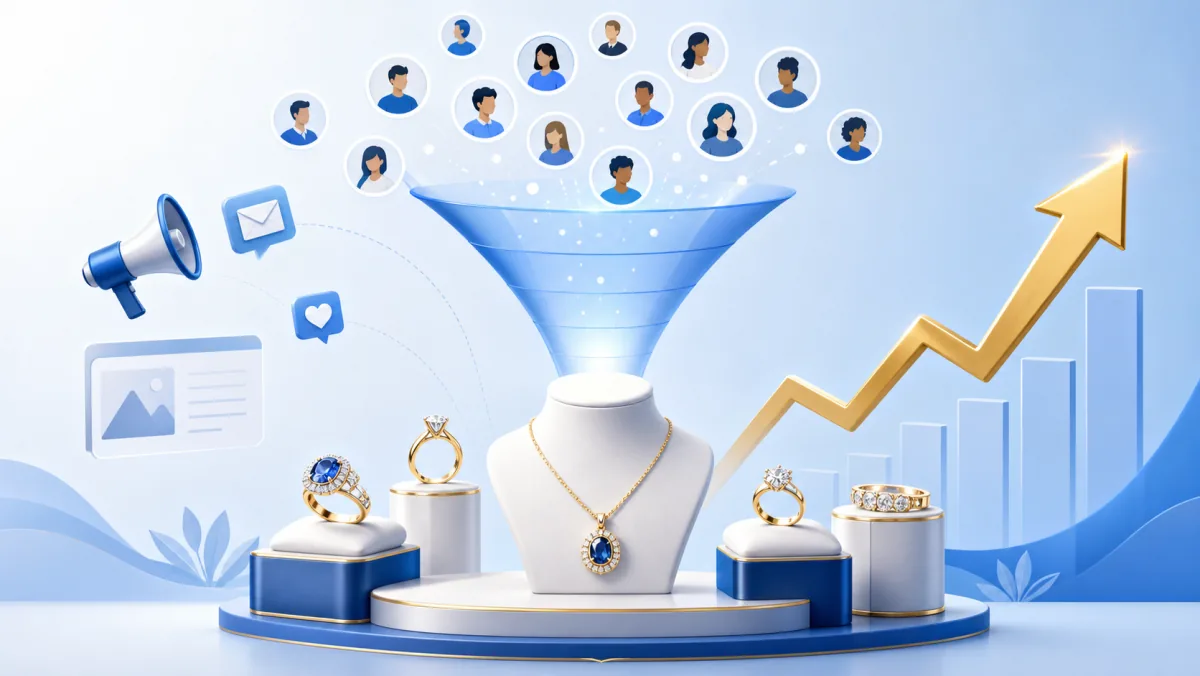
The jewelry purchasing process is long and emotional. Typical flow: inspiration (social media) → research (price, setting, model) → comparison (3+ brands) → store visit → purchase. The first three steps of this path are entirely digital. The jeweler's job is not to wait in the store, but to be visible and reliable in these three steps.
What does the buyer do during the three-month research period?
At the beginning of this period, the buyer looks for a model: photos he saves, screenshots he sends to his friend, “how is this?” His messages belong to this period. In the middle, he learns the price logic and setting; Finally, he shortlists two-three stores and visits them physically. When a jeweler's content calendar is structured around these three phases — model, information, invitation — the same person will encounter the store three times, each time for a different reason.
Where in this path does the jeweler lose?
The loss mostly happens in the last two steps. The buyer likes the model, writes a message and receives a response hours later; Or the answer to the price question is "write in private" and the conversation ends there. No matter how good the store's window display is, a store that does not make it to the short list will not display that window at all.
That's why measurement should also look at the whole journey: not how many people saw it, but how many people texted it, how many were contacted within an hour, and how many came to the store. When these four numbers are written side by side, it becomes obvious which step the problem is in.
Which channel is useful at which stage?
| Channel | At what stage | strong point | To be measured |
|---|---|---|---|
| Instagram / Reels | Inspiration + discovery | Visual product, wide reach | Profile→message, save |
| Telegram | Announcement + verbatim | Widest reach, fast communication | Message, channel growth |
| Google Ads | Comparison + decision | Captures active caller | Search, directions, form |
| Local SEO / Maps | Decision + visit | "Jewellery near me", free | Directions, search |
| website / catalog | Research + comparison | Price/model transparency | Catalog viewing, communication |
| Store | purchase | touch, try, trust | Visit→sales ratio |
The correct way to use the table is not to choose a channel, is to match the stages: If Instagram provides inspiration, there should also be search visibility to capture the decision stage. A store that is strong on social media alone will lose the ready buyer to its neighbor who searches for "jewelry store near me"; If the store is only visible on the map, it will never be on that buyer's short list. That's why the rightmost column is the most important — each channel has its own unit of measurement, and measuring them all by number of followers is the most common mistake.
What gains buyer's trust?
The biggest obstacle in jewelery is not the price, reality is doubt: is the setting correct, is the stone real, is the price fair? These doubt-reducing signals translate directly into sales — hallmark and certification information, clear pricing logic (grams + labor), real customer reviews, the store's physical location, and years of experience. As the doubt decreases, the buyer chooses you over the unknown seller who sees the same product cheaper.
Where should trust signals appear?
It is not enough for these signals to exist; They must stand where the decision is made. Setting and certificate information should be visible in the description of the product photo, price logic should be visible on the catalog page, address and working hours should be visible in the map profile, and comments should be visible at the top of the profile. A certificate sitting at the bottom of the "About Us" page produces the same result as a certificate that doesn't exist at all.
The best moment to collect reviews is right after the sale: the customer is still satisfied, the product is still in his hands. A single link added to the end of a short thank you message sent the day after submission will generate several genuine comments per month. Disconnected from the moment of purchase, the requested review almost never comes months later.
How to move from digital to store (O2O)?
Jewelry is largely sold in-store; the task of digital Bringing the right person to the store. Factors that enable this: Seeing the model on Instagram and asking "is it in stock?" ', fast response from Telegram, clear location and directions on the map, a greeting that recognizes the customer who says "I saw it on the internet" in the store. The measurement is also made accordingly: not the follower, person who comes to the store and buys is counted.
O2O's weakest link is the inside of the store. When a customer who saw it on the internet says "The model I saw on Instagram" and the sales staff does not recognize that model, all digital effort is lost in that sentence. A simple habit of posting a shared list of products behind the counter once a week makes a conversion difference that no advertising budget can buy.
The cheapest way to measure is in the store: ask every customer who comes in "where did you see us?" and mark the answer in a notebook. A month later, this ledger shows which channel actually brought people in — with more clarity than any analytics setup could ever provide, because it's the person walking through the door that counts, not the site visitor.
How will the 2026 tax change affect jeweler marketing?
As of January 1, 2026, the VAT exemption applied to the sale of jewelry and semi-finished products made of precious metals and stones in Uzbekistan has been abolished; At the same time, the separate levy on the retail sale of gold jewelery was also repealed. The result for the store can be summarized in one sentence: the price structure has changed and competition can no longer be carried out only on sticker price.
Value expression instead of price competition
When the tax burden increases similarly across the industry, trying to be the cheapest is a margin-destroying race. The stores that survive make up the difference not with price but with expression: adjustment certificate, quality of workmanship, repair and maintenance assurance, exchange conditions. These are services already offered; What is missing is their visibility in the storefront and on the internet.
Transparent pricing breeds trust
A store that clearly shows how the price is made up — price per gram, craftsmanship, stone — reduces customer suspicion in a time of rising prices. The approach that hides the price and says "let's talk" has the opposite effect in the same period.
This change is not a threat from a marketing perspective, but an opportunity for differentiation: for the first time, the difference between the store that can disclose the price and the store that cannot, becomes so visible. The store that silently reflects the increase on the label loses customers; Explaining the reason for the increase and what was received in return, the store may defend the same price. (Source: NORMA.uz / buxgalter.uz)
What do industry figures say?
Jewelry is a thoughtful category: no one buys a ring the first minute they see it. This means conversion rates are naturally low and decision time is long. Industry comparisons published for 2026 clearly show this picture.
| indicator | Sector value | What it means for the store |
|---|---|---|
| Conversion rate (online) | ~0.95-1.46% | 1-2 purchases out of 100 visitors; Conversion should be studied, not traffic |
| Mobile traffic share | ~74% | Everything should work on the phone first |
| Cart abandonment rate | ~78% | Follow-up message is the single most profitable intervention |
| Repeat purchase | ~38% (e-commerce avg. ~28.5%) | Existing customer is more valuable than new customer |
| Average basket (luxury/jewellery) | ~$364 | Separate message required per segment |
| Personalization effect | ~+28% in conversion, ~+20% in cart | "Same campaign for everyone" is the most expensive option |
This table is not top-down, from the second and third line read: if three-quarters of the traffic comes from the phone and three-quarters of the carts are abandoned, the first thing to do is not to increase the advertising budget, but to fix the phone experience and tracking message. Doubling traffic when the conversion rate is around 1% means pouring twice as much water into the same leak.
Segment determines the message
In the same comparisons, fashion jewelry, mid-segment and real jewelry are in very different basket sizes. This means that a single advertising message cannot cover all three segments: the gift seeker and the engagement ring seeker will not be persuaded by the same campaign.
The fact that the repeat purchase rate is above the e-commerce average tells you that the jeweler already has the most profitable list: past customers. A store with a registered birthday, anniversary and wedding date can send a message with a ready-made reason several times a year; The cost of this message is close to zero and no advertisement can reach such a high-intent audience. (Source: 2026 jewelery marketing benchmarks)
What to do in the first 90 days?
The first thing a jewelry store should do digitally is not to advertise, but to complete the purchase path. The program below is designed for a store that has a storefront but has a weak online side.
| Period | Focus | to be done | To be measured |
|---|---|---|---|
| 0-30 days | Visibility and trust | Google/2GIS profile, product photo standard, review collection, message channels in one place | Profile views, number of incoming messages |
| 31-60 days | Request | Advertisement for 2 product categories, short video, in-store "find on social media" reminder | Cost per message, arrival in store |
| 61-90 days | Repetition and loyalty | Customer list, special day reminders, maintenance/cleaning service announcements | Repurchase rate, number of recommendations |
The order of the program is not accidental: First availability, then demand, lastly again. A store that runs an ad with a missing Google/2GIS profile loses the interested person because they almost get to the door and can't find the address. Most of the first thirty days can be ad-free; This is not a delay, it is the preparation that determines the productivity of the next two months.
The most skipped part of this calendar is the 61-90 day interval. If the names, products purchased and special dates of the customers who came in the first two months were not recorded, the third month starts from scratch again; If saved, the same list becomes the cheapest sales channel for the following year. (Source: 101digital's application experience)
How to plan a marketing budget?
Because basket size is high in jewelry, a single sale often accounts for a significant portion of the monthly marketing spend. The critical thing is which item to start with first.
| pencil | Home | What does it do? | priority |
|---|---|---|---|
| SMM (Instagram/Telegram) | $250/month | Product visuality is the primary sales tool in this industry | 1 |
| Google/2GIS profile + comment | labor | Searches for "jeweller near me" | 1 |
| Landing page (collection/campaign) | $300 | Turns advertising into sales | 2 |
| Google Ads | $400/month | High-intent searches such as engagement rings | 2 |
| CRM + special day reminder | $500/month | Connects repeat purchasing to the system | 3 |
| Online store / catalog site | from $800 | Opens its storefront outside the city | 3 |
The amounts in the table are not a menu, is the starting threshold: Instead of opening all the items at the same time, you start with the 1's in the priority column and move on to the 2's after the first numbers appear. The right start for a small store is usually two items — the visual content and the map profile — because without these two, the results of the other items cannot be measured. (Source: 101digital 2026 service price list)
Ranking in jewelery is different from other industries: here visual content comes before search advertising; Because the product is first liked and then sought after.
How to convert incoming messages into sales?
The output of advertising in the jewelery store is the message, not the sale. "Is this ring in stock?", "Is it 22 carat?", "How much does it cost?" — These three questions, which come at all hours of the day, are actually the questions of the people closest to buying. This is where most stores lose money: the message arrives, it is answered late, the response is incomplete, and the buyer moves on to the next account.
How long should the first response take?
The practical criterion is simple: respond while the recipient is still on their phone. Returning the next morning to a message written in the evening means starting the conversation from the beginning; because that person wrote to three other accounts in the intervening hours. A one-sentence greeting prepared for after-hours and a real response in the first minutes of the next day prevents most of this loss.
The way to improve response time is not to work harder, but to collect messages in one place. When Instagram, Telegram and phone are followed separately, one of them is bound to be forgotten; When they all land on a single screen, the answering task ends in two short rounds a day.
How to answer the price question?
The answer "Write privately" means hiding the price in the eyes of the buyer and reduces trust. However, it is not necessary to give the exact number: Explaining the logic consisting of gram weight, workmanship and current gold price in a single sentence sets the expectation correctly and does not leave the store under a false promise when the price changes.
After the price response, the next step must be suggested: a photo of two similar models, availability or an invitation to try it in the store. A conversation with no questions left at the end usually ends there.
How to link correspondence to store visit?
A vague invitation ("We are waiting for you, sir") does not work. The likelihood of a visit increases significantly when given a concrete framework such as address, nearest stop, opening hours and “we are open until 19:00 today”. The strongest form of invitation is to distinguish the product by name: "Shall we put it aside for you until the evening?"
It is equally important to know the person coming. A staff member in the store who can say "we corresponded with you on Telegram" both increases the conversion and records the source of that sale; Thus, which channel produces turnover at the end of the month becomes data, not guesses.
What are the most common mistakes in jewelry marketing?
bad product photo
In jewelry, photography is the product itself. A ring shot in bad light with a cluttered background looks cheap, no matter how good it actually is. A fixed shot setup — same background, same lighting, same angle — alone increases the perceived quality of the store.
Hiding the price completely
An account that does not provide any price information also eliminates serious buyers. Providing at least a range or "in this grammage and in this band" information increases the quality of incoming messages and saves the time of sales personnel.
Appearing only during campaign periods
An account that only posts during holidays and discount periods will not be remembered for the rest of the year. However, there are reasons for purchasing every month, such as engagement, anniversary and birthday; regular visibility captures this demand.
Not updating stock and price information
A model that was shared months ago and is no longer in stock will turn every message you receive into disappointment. Writing a one-word note under the product sold or archiving the post is a matter of seconds; When not done, the sales team repeats the same statement every week and the buyer concludes "this store is out of date."
Measuring the result by the number of followers
It is very common in jewelers for sales to stagnate while followers increase; Because beautiful product photos attract appreciation from people outside the city. Changing the metric to “came and got it” often changes the content strategy as well: posts that seek reach are replaced by posts that stimulate the nearby buyer.
real cases
Our Client Results in This Area
Meta Ads and Google Ads management for an Uzbek container terminal and warehousing operator. Work has just begun.
Digital marketing for a Tashkent-based IVF and women's health center
Google Ads management for Turkey's sole authorized representative for West Africa cargo tracking certificates
checklist
Review the following five questions once a month, preferably as the month closes. The digital side of a store that can say "yes" to all of them is working; The first "no" is the priority task of that month.
- Is the product + price logic visible on Instagram?
- Is there a quick response on Telegram?
- Is the Google/2GIS profile complete and collecting comments?
- Is setting/certification information clearly stated?
- Is the source of the customer coming to the store asked?
Related articles
This article gives the general framework; The following articles discuss each channel one by one. For general market figures Uzbekistan Digital Marketing Statistics 2026 You can also look at our report.
- Instagram and Reels for Jeweler: How to Create Content That Sells Jewelry?
- Season Campaign at Jewelry Store: Planning Wedding, Holiday and Gift Periods
- Trust in Jewelry: How to Establish Settings, Certifications, Reviews and Brand Reputation?
- Google Ads for Jewelers: Bringing Purchase Intent Search to the Store
- Jeweler Website and Catalog: The Right Way to Move Your Showcase to Digital
How does 101digital set this up?
We establish Instagram/Telegram content flow, Google Ads and local SEO, trust signals and store referral measurement as a single system for jewelers. The target is not liking, but the buyer who comes to the store. → Digital marketing services
Yes. According to industry data, 68% of engagement ring buyers compare at least 3 brands and 64% start researching at least 3 months before purchasing. Most of this process takes place digitally.
There is no single channel: Instagram captures inspiration and discovery, Telegram captures the quick communication, Google Ads and local SEO capture the decision stage. In jewelry, these channels complement each other.
Yes, even more necessary. In jewelry, the decision is made in the store, but the research is done online; The jeweler who does not appear digitally is excluded from this research.
It's not the price, it's the doubt of authenticity: is the setting correct, is the stone real, is the pricing fair. Setting/certification information, transparent price logic and real reviews reduce this doubt.
Not by followers and likes, but by the number of people who come to the store and buy. "Where did you see us?" Asking is the simplest and most reliable measurement method.