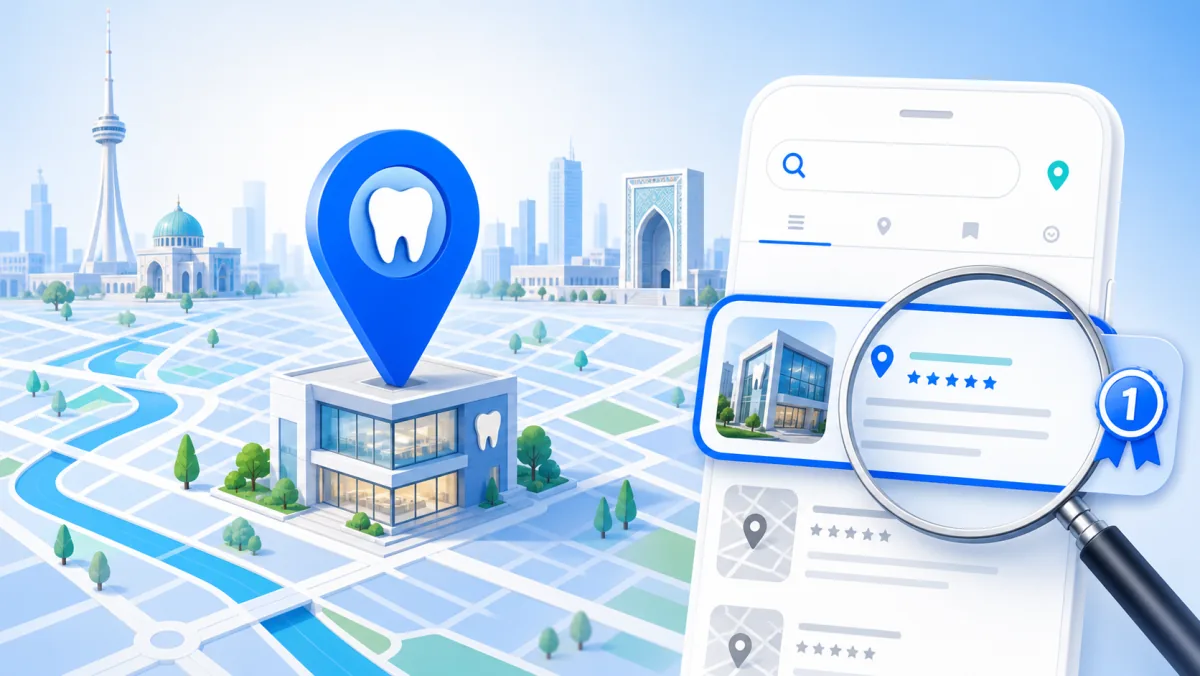
Most patients searching "dentist near me" book from the Google map, not the website. That makes Google Business Profile (map) optimization the highest-return, often ad-free channel for a dental clinic. This article covers the steps to rank in the map and the local SEO signals that matter.
Short answer
Winning the "dentist near me" search comes down to three jobs: completing the Google Business Profile, collecting genuine reviews on a steady rhythm and keeping name, address and phone identical everywhere. Google builds map placement from proximity, relevance and prominence; you cannot change proximity, but the other two are fully in your hands. A 2GIS profile and district-level pages reinforce all three, and the first visible movement usually shows up in profile insights within 4–8 weeks.
How does "near me" search work?
In local search Google weighs three factors: proximity (distance to the user), relevance (how complete and accurate the profile is) and prominence (reviews, reputation, web signals). You can't change proximity, but by optimizing relevance and prominence you become visible over a wider area.
What sets this search apart is intent: the user is not researching, they are usually looking for an appointment today. Falling outside the top three map results therefore does not mean "being fourth" — in practice it means not existing. And the decision is not made on your homepage: rating, distance, the "open now" label and the tone of the latest reviews settle it right there on the profile card.
How do you optimize a Google Business Profile?
Basic but often missing: the right category (dentist + sub-services), complete and current info (address, phone, hours), a service list, real photos (clinic, team, before/after) and regular posts. A complete profile signals to Google that the clinic is trustworthy and active.
Google Business Profile: which element affects what
| Element | Signal affected | If skipped | Priority |
|---|---|---|---|
| Correct category + service list | Relevance | You appear for the wrong searches | High |
| Reviews (50+, steady) | Prominence | You stay below competitors | Very high |
| Real photos (clinic, team) | Relevance + trust | Click-through drops | High |
| Complete info (address, hours, phone) | Relevance | Enquiries get lost | Very high |
| NAP consistency (all platforms) | Trust | Google can't verify, ranking drops | Medium-high |
| Regular posts/updates | Activity | Profile looks "dead" | Medium |
Why this matters: industry compilations show practices with 50+ reviews and a fully optimised profile win 60–70% of new patients from organic local search — with no incremental cost per click. For comparison, a new patient via Google Ads costs $150–300 ($350–500 in competitive markets). In Uzbekistan 89% of users go online via mobile, making the map the practical first point of contact. (Sources: 2026 dental marketing benchmarks; DataReportal Digital 2026)
The practical way to use the table is to read the rows top to bottom and stop at the first one that is still open. Until the two "very high" rows — reviews and complete information — are closed, working on post copy is spending time on the lowest-return task. Running this self-check once a month produces results faster than waiting for a quarterly agency report.
(Source: 2026 dental marketing benchmarks — organic new-patient share of profiles with 50+ reviews and the paid cost-per-new-patient range)
Why are review and photo signals so strong?
Review count, rating and recency are among the strongest local-ranking signals. A steady stream of genuine reviews plus professional replies lifts both ranking and trust. Patient and clinic photos strengthen the relevance signal.
The words patients use matter too: reviews that name a service — "implant", "root canal", "children's dentist" — strengthen relevance for exactly those searches. That is why asking "if you were happy, could you also mention which treatment you had?" is worth more than simply asking for a star rating.
With photos the test is honesty, not polish. Current shots of the entrance, the waiting area and the actual team answer the patient's "am I going to the right place?" before they reach the door. A profile built from stock images does the opposite: it creates a gap between expectation and reality on the first visit, and that gap often turns into a negative review.
How does NAP consistency affect ranking?
NAP (name, address, phone) must be identical across all platforms. Different spellings (an old phone number, a different address format) weaken Google's trust. Consistent NAP across directories and maps confirms the clinic is real.
In practice the phone number breaks first: the clinic changes its number, updates the Google profile, and the old number stays in the 2GIS listing, the social media bio and two or three directories. A simple audit twice a year — search the clinic name and open every record that appears — fixes this for free, and most clinics never do it.
What do 2GIS and local content add?
In Uzbekistan, 2GIS is as important as Google Maps; both need a complete profile. On top of that, district-level content on the site ("implants in Chilanzar", "Yunusabad dental clinic") boosts local relevance and captures long-tail searches.
In Uzbekistan people open the map on a phone, which makes how the profile looks on a mobile screen the first question to answer (market data: Uzbekistan Digital Marketing 2026). District-level pages then cover what the map cannot reach: on searches such as "implant price in Chilanzar" the user reads first and only afterwards looks at the map.
What determines local ranking?
Map placement is a combination of three factors, and only two are within your control. Knowing this saves wasted effort.
| Factor | What it means | In your control? | How to strengthen |
|---|---|---|---|
| Proximity | Distance to the searcher | No | Cannot change; strengthen the other two to appear across a wider area |
| Relevance | How well the profile matches the query | Yes | Correct category, service list, complete data, description |
| Prominence | How known and trusted the business is | Yes | Review count and rating, web signals, directory consistency |
The practical conclusion: proximity cannot be changed, so the only way to stand out from competitors at the same distance is relevance and prominence. That is why collecting reviews and completing the profile is not a "nice to have" but direct ranking work.
Use the table like this: score yourself and your two nearest competitors separately on each of the three rows. If you lose on proximity, you have to be clearly ahead on relevance and prominence — until that gap closes, you will not appear for searches made from further away.
(Source: Google's published guidance on local ranking — the proximity, relevance and prominence factors)
How do you set up the profile step by step?
1. Category selection
Choose the most specific primary category ("Dental clinic", "Real estate agency"), then add secondary ones. A wrong primary category means not appearing for the right searches, and changing it later temporarily shakes rankings.
For secondary categories the test is simple: only treatments the clinic actually performs. Adding a category for a service you do not offer lifts impressions briefly, but almost none of those enquiries turn into appointments. If profile views are climbing while calls stay flat, this is usually the reason.
2. Complete the information
Address, opening hours, phone, website, service list and a short description. A profile with gaps loses to a fully completed competitor. Hours matter especially: an "open now" label converts directly into clicks on urgent searches.
3. Real photographs
Exterior (so you can be found), interior (trust), team (a human face) and work examples. Stock images reduce trust; an honest phone photo works better than a polished stock picture.
Adding a few frames across the month works better than uploading everything at once and forgetting it, because recency is a separate activity signal. The exterior shot should show the sign the way it looks from the street; when patients cannot find the entrance, they usually say so in a review.
4. Review flow
Once set up, the first goal is to catch up with competitors on review count. A few reviews weekly beat a monthly batch, because recency is a separate signal.
Leaving the review flow to whichever staff member remembers is the most common failure. The routine that works: treatment ends, reception sends a short link while payment is taken, and the number of reviews received is logged in one place at the end of the day. Three or four genuine reviews a week close a competitor's lead within three months.
5. Regular updates
Posts, new photos, current hours. A profile untouched for months signals to the algorithm that the business is inactive.
The easiest source of updates is the clinic's own calendar: new equipment, a new dentist, holiday opening hours, or a short answer to a frequently asked question. Two posts a month are enough for this; what matters is not frequency but that the profile never looks untouched for months.
How do you build local SEO in 90 days?
| Period | Focus | Work | Expected |
|---|---|---|---|
| 0–30 days | Foundation | Complete profile, category, photos, NAP audit, 2GIS listing | Rise in profile views |
| 30–60 days | Prominence | Review-collection routine, first posts, local page on the site | Steady growth in reviews |
| 60–90 days | Expansion | District-level content, internal linking, replies to reviews | Visibility for "near me" searches |
Unlike advertising, local SEO is slow but lasting: first results usually appear within 4–8 weeks and do not vanish when budget stops. As the lowest-cost channel, it should therefore be the first system you build.
The critical point when running this programme is not to break the order: a clinic that starts collecting reviews with an incomplete profile loses the interest it earns to missing information. At the end of each stage one question is asked — "did this stage produce its expected output?" If not, you do not move on; the same work continues for another month.
(Source: the 101digital's delivery experience on local SEO projects — work split across the 0–30 / 30–60 / 60–90 day stages)
How do you measure local SEO results?
The output of local SEO is not ranking but actions taken from the business profile. Track in profile insights: calls, direction requests, website clicks and views. The most valuable are directions and calls — both signal intent to visit.
The second measurement layer is how you were found: insights separate "discovery" (service search) from "branded" (name search). If the discovery share is growing, local SEO is working; if only branded searches arrive, you have not yet reached a new audience.
Comparison is what makes measurement meaningful: put the month next to the previous month and, where possible, next to the same month last year, because dental demand is seasonal. Changing the profile because of one weak week does not improve the result — it only breaks the measurement.
(Source: metrics reported in the Google Business Profile insights panel — calls, direction requests, website clicks)
How do you handle the map with more than one location?
A separate profile per location
Running two locations from one profile is the most expensive mistake: Google expects a separate listing for every physical address, and a single profile leaves you out of searches in the second location's district entirely. Each branch is created on its own, with its own address, phone number and opening hours.
Reviews belong to the location
Reviews are counted per profile, so a new branch starts from zero; the head clinic's hundreds of reviews do not carry over. The first three months of a new branch are therefore planned as a dedicated review-collection period, with reviews asked from patients treated in that district.
Content separates by location too
The site gets a page per branch: that branch's address, directions, team list and the questions specific to that district. Copying one text onto two pages weakens both; the difference should be as concrete as which street the sign is on.
In short, in a multi-location clinic map work is not one enlarged task — each branch runs its own race inside its own proximity zone. Budget follows the same logic: as the number of branches grows, review collection and content work grow linearly with it.
What should you do if map ranking drops?
First check what changed in the profile
The most common cause of a drop is not the algorithm but a change made to the profile: a category update, an address correction, keywords added to the business name, or an edit suggested by a user and accepted by the system. Open the profile's change history, roll back the last change and wait two weeks.
Is there a duplicate listing?
A second listing created under an old address splits the signal and pushes both cards down. Search the map for the clinic name and the old phone number; if a duplicate exists, file a request to close or merge it. The work is done once and the effect lasts.
Or has a competitor got stronger?
Sometimes nothing on your side is broken — a competitor down the street simply started collecting reviews consistently. The check is easy: note the review count and the date of the latest review for the top three results. If the competitor gained more reviews than you last month, the fix belongs to your review routine, not your profile.
What you should not do after a drop is change the category, the description and all the photos in the same week. Make one change, wait two weeks and compare profile insights; otherwise you will never learn which move worked.
What are the common local SEO mistakes?
Staying on one platform
In Uzbekistan 2GIS is used as widely as Google. Being strong only on Google means being invisible to a large share of users.
Leaving category and services empty
These are the main source of the relevance signal; every empty field hands a point to a competitor.
Inconsistent NAP
Different phone numbers or address formats across platforms reduce Google's confidence that the business is real. Fixing it is free, yet most businesses never check.
Not replying to reviews
A profile without replies looks passive. A short thank-you for positives and a professional reply to negatives signals activity to both users and the algorithm.
Buying reviews in batches
Reviews that arrive within a couple of days, read alike and mention no treatment detail look fake to users and to platform filters alike. During a cleanup genuine reviews often disappear along with them; the time lost is far greater than the calm, steady collection you skipped.
Not reporting a change of address, hours or category
If a move, a new branch or a schedule change is not entered into the profile, patients arrive at a closed door and write about it in a review. A single incident hits the rating and the prominence signal at the same time — while the update itself takes a few minutes.
Checklist: how do you use it?
The list below is built for fifteen minutes once a month. If an item answers "no", that is the work for the month; if several answer "no", follow the order given, because the upper items are preconditions for the lower ones.
- Is the primary category correct and the service list complete?
- Are address, phone, opening hours and holiday closures current?
- Did at least three new genuine reviews arrive this month?
- Have all reviews from the last 30 days been answered?
- Were new photos or posts added this month?
- Is the NAP identical on Google, 2GIS, the site and social accounts?
- Are there duplicate or old-address listings still live?
- Did calls and direction requests from the profile grow versus last month?
Real case studies
Our Client Results in This Area
Meta Ads and Google Ads management for an Uzbek container terminal and warehousing operator. Work has just begun.
- Status
- Just started
- Scope
- Meta Ads + Google Ads
- Facilities
- Angren terminal + Andijan warehouse
Digital marketing for a Tashkent-based IVF and women's health center
- Leads · on half the budget
- Increased
- Scope
- Website, SEO/GEO, social ads, CRM, brand consulting
Google Ads management for Turkey's sole authorized representative for West Africa cargo tracking certificates
- Target Markets
- Turkey, Europe, Americas
- Sector
- B2B Logistics
- Campaign Type
- Google Ads
Related reading
How 101digital handles this
We optimize the Google Business Profile + 2GIS, set up review collection, audit NAP and build local content to rank your clinic for "near me" searches. → SEO service
Most "dentist near me" searches convert from the map and are usually ad-free. A clinic with an optimized profile earns steady bookings at low cost.
Completeness and recency: the right category, full info, a service list, real photos and regular genuine reviews. These are relevance and prominence signals.
There is no fixed number; having more and fresher genuine reviews than competitors matters most. Consistency beats a one-time batch.
Yes. In Uzbekistan 2GIS is widely used; both Google and 2GIS profiles should be complete and consistent.
Identical name-address-phone across platforms raises Google's trust. Inconsistent spellings weaken ranking and the perception of legitimacy.