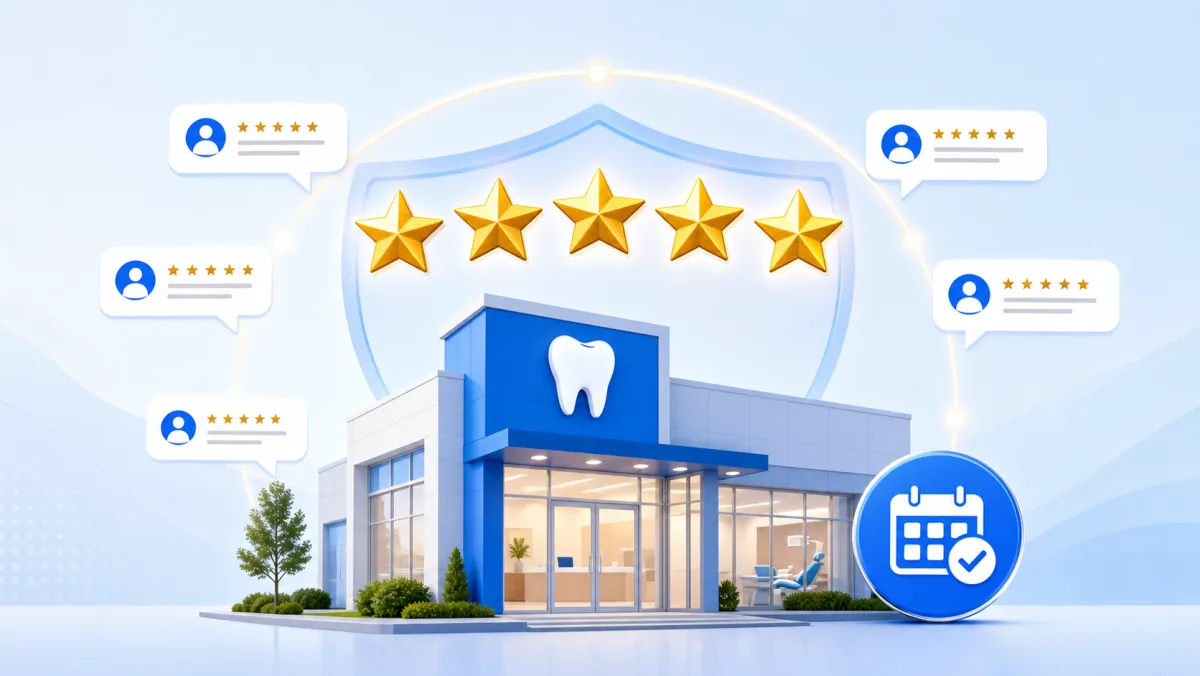
When choosing a dental clinic, patient reviews often matter more than price — because dentistry is about trust. Before picking a clinic, a new patient checks the Google and 2GIS rating, how genuine the reviews look, and how the clinic responds to them. The good news: reviews and reputation are not a matter of luck but an asset you can build systematically.
Short answer
Dental reputation comes down to three jobs: collecting reviews regularly, replying professionally to every review, and making the dentist visible. The benchmark is not an absolute number but having more and fresher genuine reviews than competitors in your district. Buying reviews cancels all three: once detected the profile takes lasting damage, and the visibility you lose cannot be bought back with ads.
Why are reviews the #1 factor?
In health decisions the perceived risk is high; the patient acts out of fear of “choosing the wrong clinic.” What reduces that fear most is social proof: many recent, genuine reviews. A clinic with a high rating and many reviews on Maps is both more visible and more trusted. So reviews are not only reputation — they are a local SEO signal.
In numbers: industry compilations show a practice with 50+ Google reviews and a fully completed profile wins 60–70% of its new patients from organic local search — a channel with no incremental cost per click. For comparison: marketing-generated leads convert to appointments at 35–50%, while referred patients convert at 60–80%. Collecting reviews is therefore not just reputation work but a direct reduction in acquisition cost. (Source: 2026 dental marketing benchmark compilations)
What review volume changes
| Situation | Map visibility | Source of new patients | Cost |
|---|---|---|---|
| Few/old reviews, incomplete profile | Low — below competitors | Mostly paid advertising | ~$150–300 per patient |
| Steady reviews + full profile (50+) | High — top of the map pack | 60–70% of new patients organic | No incremental cost per click |
This table is not a target but a position check: mark which row your clinic sits in today. If it is the top row, the problem is the system rather than the budget — building the review flow before raising ad spend produces more bookings from the same money. If it is the bottom row, what you protect is recency, not the count: the moment the flow stops, the profile slowly slides back up into the first row.
How does a review-collection system work?
Most clinics wait for “a happy patient to write on their own” — but usually they don’t. A working system is simple: send the happy patient a short review link at the right moment (as they leave, or after a check-up). A QR code, SMS or Telegram link to the Google/2GIS review page noticeably increases their number. Consistency matters: a few reviews every week beat a once-a-month batch.
How should negative reviews be handled?
A negative review is inevitable and does no harm by itself; the harm comes from a bad response (or none). A professional, non-defensive reply that offers a solution often looks positive to a prospective patient. The rule: never argue, never breach patient privacy, invite the person to resolve it offline.
How does the dentist behind the reviews build trust?
The strongest amplifier of reviews is the real dentist behind them. Name, specialty, photo and a short video intro connect reviews to a real person rather than an abstract score. Trust = social proof (reviews) + authority (the dentist) + consistency (fresh, genuine content).
How do you build review collection step by step?
Reviews arrive because they are asked for, not because they are awaited. The four steps below cost nothing but are simply not set up at most clinics.
1. Pick the right moment
The highest response rate comes right after treatment or a check-up, when satisfaction peaks. A request sent a week later usually goes unanswered.
2. Remove the friction
Telling a patient to "search for us on Google and leave a review" does not work. You need a short link straight to the review page: a QR code at reception, then the same link via Telegram or SMS.
3. Assign an owner
Who sends it and when must be written down. The "whoever remembers" approach dies within two weeks. Building it into the reception's daily routine is the most sustainable option.
4. Measure weekly
The goal is a few new reviews every week, not a batch once a month. Recency is its own signal for Google, so a steady flow beats a one-off campaign.
How many reviews are enough, and how do you benchmark?
There is no absolute number; the benchmark is always competitors in your area. Search "dental clinic" in your district and record the review count and rating of the top five — your target is to move above that list.
| Situation | How it looks | Result | Priority |
|---|---|---|---|
| 0–10 reviews | New or neglected profile | Invisible on the map, low trust | Urgent |
| 10–50 reviews | Average clinic | Visible but competitors rank higher | High |
| 50+ with steady flow | Optimised profile | 60–70% of new patients from organic local search | Maintain |
| Many but old reviews | Abandoned profile | Weak recency signal, ranking slips | Restart |
The critical figure: industry compilations show clinics with 50+ reviews and a fully optimised profile win 60–70% of new patients from organic local search — at no incremental cost per click. The same patient via Google Ads costs $150–300. Collecting reviews is therefore not reputation work but direct cost work. (Source: 2026 dental marketing benchmark compilations)
Which review sources matter most?
| Source | Impact | Difficulty | Note |
|---|---|---|---|
| Google reviews | Very high | Medium | Directly affects map ranking |
| 2GIS reviews | High (Uzbekistan) | Medium | Used as widely as Google locally |
| Instagram comments/DMs | Medium | Easy | No ranking effect, but builds trust |
| Video testimonial | Very high | Hard | Most persuasive, least used format |
The decision this table forces is simple: give the weekly routine to Google and 2GIS, treat Instagram as trust support rather than a ranking tool, and plan at least one video testimonial a month. Most clinics do the opposite — they spend their energy on the channel that has no effect on map ranking and stay below a competitor in search results.
How do you reply to a negative review?
A negative review rarely does damage on its own; the damage comes from silence or a defensive reply. A prospective patient usually looks less at the review than at how the clinic behaves.
A reply template that works
Thanks + brief regret + a solution offered without admitting fault + an invitation to make contact. For example: "Thank you for the feedback. We are sorry about your experience; please get in touch so we can clarify and resolve it." Three sentences show professionalism without argument.
What never to do
Disclosing treatment details (a privacy breach), publicly disputing whether the review is genuine, posting multiple defensive replies to one person, or ignoring the review entirely. All of these harm more than the negative review itself.
How do you measure the return on reputation?
The effect of review work shows in three places: calls and direction requests from the map profile, branded search volume, and the conversion rate of patients arriving from ads. The third is usually overlooked: strong reputation makes the same ad budget produce more bookings, because the person who clicks is convinced once they check you out.
For comparison, industry data: patients from advertising convert to appointments at 35–50%, while referred patients arriving with trust convert at 60–80%. That gap is the measurable return on reputation work. (Source: 2026 dental marketing benchmark compilations)
What should you do in the first 90 days, and how do you plan the budget?
If review work starts from zero, the right question is not "how much budget" but "which task in which month". Most of this work needs routine rather than money; the only resource genuinely spent is a few minutes of reception time each day. A real cost line appears only at the video-testimonial and profile-photography stage.
| Period | What gets done | What you measure |
|---|---|---|
| 0–30 days | Complete the Google and 2GIS profile, set up the QR code and short review link, assign an owner | New reviews per week |
| 30–60 days | Write the reply protocol, answer every past review, activate the second platform | Share of reviews answered |
| 60–90 days | Pull the map profile statistics, publish dentist introductions and the first video testimonial | Calls and direction requests from the profile |
0–30 days: build the profile and the flow
The first month serves one goal: making the review request part of the clinic's routine. Profile details (opening hours, service list, contacts, photos) get completed, a QR code goes on the reception desk, and it is written down who sends the request. Even with zero ad spend, review volume starts rising this month.
The most common mistake in this period is trying to collect new reviews and answer old ones at the same time. Done together, both stay half-finished. Build the flow first; leave the replies to month two.
30–60 days: reply protocol and the second platform
The second month clears the backlog. Positive reviews get a short thank-you, negative ones a non-defensive reply that offers a solution, and who replies in what tone is fixed in a one-page protocol. Without a protocol, replies vary from person to person and the profile reads as inconsistent.
The second platform goes live in the same month. Being strong on Google and empty on 2GIS means the clinic is simply absent from a meaningful share of searches; filling both with the same information is not a cost line but an afternoon of work.
60–90 days: measure and connect it to advertising
The third month is the measurement month. Calls and direction requests from the map profile, branded search volume, and the booking conversion rate of ad-sourced patients are pulled together. Read side by side, these three numbers show how reputation makes the advertising budget go further.
The first genuine cost line also appears now: filming video testimonials and professional clinic photography for the profile. Both are one-off investments used for a long time, not monthly expenses.
The goal of ninety days is not to top the competitor list but to move the review flow off one individual and onto a system. With a system in place, ranking follows on its own within months; ranking won without a system disappears in the first busy week.
Can an unfair or fake review be removed?
This is the most asked and most misunderstood part of review management. The short answer: a review is not removed simply for being negative. Platforms only take down content that breaks their own content rules, and dissatisfaction is not a rule violation.
Which reviews can genuinely be removed?
Reviews containing abuse or hate speech, off-topic reviews describing an experience unrelated to the clinic, advertising or spam, posts exposing personal data, and clear conflicts of interest can be removed once reported. What decides the outcome is not an emotional message but a short, factual explanation of exactly which rule was broken.
What do you do with a review that stays up?
The only antidote to negative feedback that is not removed is new, genuine reviews. The weight of a single negative review falls mathematically as the total count grows, so redirecting the same energy into collecting reviews almost always works faster than chasing support tickets.
What if you suspect a review came from a competitor?
If there is suspicion, the first step is evidence: the reviewer account's history, the date of the review, and the clinic's appointment record for that date. Publicly arguing "this is fake" underneath the review is the most damaging move — a prospective patient sees the argument, not the evidence.
The practical rule: removing reviews is a defensive reflex, while collecting them is a growth system. Clinics that give most of their time to the second end up visibly higher rated a year later than those busy with the first.
What mistakes are made in review management?
Buying fake reviews
When Google and 2GIS detect this, the profile suffers lasting damage. The short-term gain is not worth the loss of visibility.
Only asking for reviews after a bad period
Review collection is a continuous routine, not a crisis tool. An irregular flow breaks the recency signal.
Never replying to reviews
Not thanking positive reviewers is also a signal: the profile looks inactive. Replies show both patients and the algorithm that the clinic is alive.
Collecting reviews only on Google
2GIS is widely used in Uzbekistan; being strong on one platform means being invisible on the other.
When should you ask for a review, and when not?
Timing matters more than wording. Ask right after treatment finishes successfully, after a check-up, when the patient thanks you unprompted, and after a difficult case is resolved. Do not ask while treatment is still ongoing, after a delay or a scheduling problem, or immediately after discussing price — at that moment the patient is evaluating cost, not care.
One more rule: never ask the same patient twice within six months. A repeated request reads as pushy and reduces their willingness to recommend you personally.
Checklist
The list below shows in ten minutes whether review and reputation work is actually set up. If most answers are "no", the problem is not the quality of the clinic but the fact that the quality is not made visible — and that is a routine problem, not a budget one.
- Both the Google and 2GIS profiles are fully completed (hours, services, contacts, current photos).
- A short link straight to the review page exists; there is a QR code at reception.
- Who sends the review request, and at what moment, is written down.
- No review is requested right after a painful procedure or from a patient with an unresolved complaint.
- Every positive review from the last 12 months has a short thank-you reply.
- Negative reviews are answered within 48 hours, without defensiveness and without breaching privacy.
- The dentist's name, specialty and photo appear both on the site and on the profile.
- Weekly new-review counts and profile calls/direction requests are reported once a month.
- No reviews have been bought; every review comes from a real patient.
Do not fill the list in once and forget it — revisit it every quarter. A review flow stops quietly: when the responsible person changes or after a busy stretch, this is usually the first task to drop out.
Real case studies
Our Client Results in This Area
Meta Ads and Google Ads management for an Uzbek container terminal and warehousing operator. Work has just begun.
Digital marketing for a Tashkent-based IVF and women's health center
Google Ads management for Turkey's sole authorized representative for West Africa cargo tracking certificates
Note: protect patient privacy in review replies; fabricating reviews is unethical and violates platform policies.
Related reading
How 101digital handles this
We set up your review-collection funnel, a negative-handling protocol and Google/2GIS profile optimization. The goal is turning trust into measurable bookings. → SEO and reputation management
There is no fixed number; recency and consistency matter. Having more and fresher genuine reviews than competitors is worth more than a one-time large count.
With a short link at the right moment (after treatment/check-up). A QR code, SMS or Telegram link to the Google/2GIS page is the most effective method. Consistency is key.
Professionally, without defensiveness, offering a solution. Don’t argue, don’t breach patient privacy, and invite them to resolve it offline.
No. Fake reviews are unethical, violate Google/2GIS policies and cause permanent damage to your profile once detected. The sustainable path is genuine reviews.
Yes. Review count, rating and recency are important local-ranking signals on Maps; a well-managed profile earns both trust and visibility.