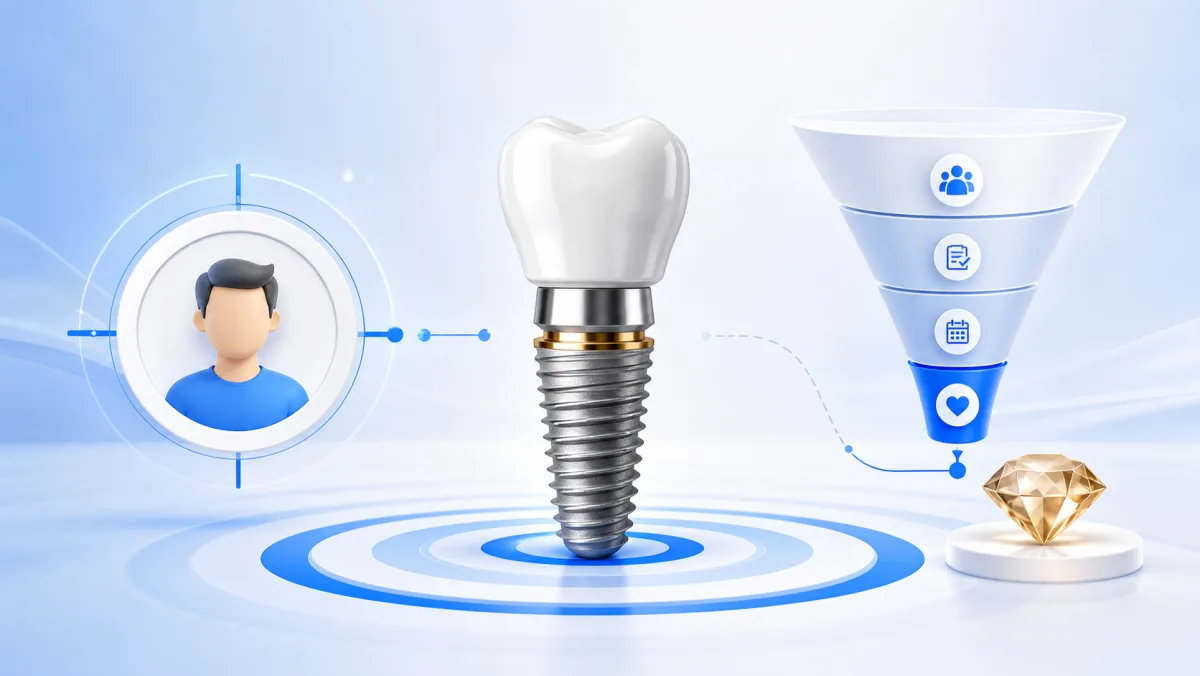
The key to attracting dental implant patients is not a cheap price ad — it is meeting the patient, who is making a high-budget decision, at the right point of their research journey. An implant is both expensive and permanent, so the patient does not arrive immediately but after days or weeks of research. Below we break down the implant patient's decision journey, the targeting logic and the high-ticket funnel.
Short answer
Attracting implant patients is not about collecting cheap clicks; it is about walking alongside a long-decision patient for the whole length of their research. The working formula has four parts: a separate campaign and separate landing page for implants, a first step that invites to a free examination rather than a sale, a price answer built as a range plus what changes it, and after the exam a written treatment plan with CRM follow-up. Raising the budget before those four exist changes nothing.
How does an implant patient make the decision?
An implant seeker usually passes three stages: awareness ("what is an implant, what are the alternatives"), comparison ("implant price", "zirconia vs implant", "which clinic") and decision ("implant clinic near me", "clinic X reviews"). Each stage needs different content and channels. A clinic that targets only the decision stage loses the patient earlier — to a competitor.
At which stage does the patient reach you?
Most clinics only see the patient at the third stage — when the phone rings. Yet the same person made their first search weeks earlier, browsed several clinic pages and probably remembered the name of one of them. A clinic that was invisible during the first two stages is not familiar at the moment of decision, merely unknown, and it gets judged on price alone.
The practical consequence: the awareness stage needs content (implant alternatives, who is not a candidate, how healing progresses), the comparison stage needs a price-range page and genuine case images, and the decision stage needs an up-to-date map listing, reviews and a channel that replies immediately. If those three are not in place at the same time, the funnel has a hole — and that hole is exactly where patients disappear.
Who should implant advertising target?
High-intent searches ("implant price", "how much is an implant", "implant near me") are expensive but bring the most valuable patient. The mistake is mixing implants into a general dental campaign. Implants need their own campaign, budget and landing page. Negative keywords ("cheap", "job") and location targeting keep the cost under control.
The concrete benefit of a separate campaign shows up in measurement: when implant searches compete inside their own budget, the true cost of one consultation is visible on a single screen and bidding decisions get easier. While the same searches sit inside a general dental campaign, cheap cleaning and filling clicks drag the average down; the real cost of implants hides underneath that average and the clinic ends up scaling the wrong channel.
In numbers: while acquiring a general dental patient costs $150–300, high-value services such as implants and cosmetic dentistry push this to $250–500, and in competitive markets Google Ads can reach $350–500. That is why "cheap leads" is the wrong goal for implants — the right goal is qualified leads. (Source: 2026 dental marketing benchmark compilations)
The implant patient's decision journey
| Stage | What they search | What they expect | Right content / channel |
|---|---|---|---|
| Awareness | "what is an implant", "alternatives" | Information, trust | SEO content, dentist video |
| Comparison | "implant price", "which clinic" | Transparency, proof | Price-range page, before/after, reviews |
| Decision | "implant near me", "clinic X reviews" | Speed, easy contact | Google Ads + maps + WhatsApp/Telegram |
| Consultation | Exam / treatment plan | Clear plan, payment options | Free-exam invitation, CRM follow-up |
Read this table as a gap list for your own clinic: for which of the four rows do you have no publish-ready asset or no channel set up? In most clinics the answer is the "comparison" row — a price-range page and consented real-result images are the two items skipped most often, and that is precisely the stage at which patients strike clinics off their list.
How is the high-ticket funnel built?
An implant patient does not "add to cart"; they arrive at the end of a process: ad → landing page → free exam/consultation → treatment plan/quote → decision. The most critical step here is the free exam/consultation call, because the patient wants to build trust first. Inviting to an exam works far better than quoting a price immediately.
Which funnel step should you measure?
Every step of this funnel must be measured separately: ad to landing page, landing page to consultation request, request to actually attending the exam, and exam to accepted treatment plan. A single "number of leads" figure hides which of the four steps is blocked; clinics often raise the ad budget while the real problem sits at the exam-to-treatment step, and they lose money doing it.
No-shows are a separate line item in this funnel. A free-exam offer lifts conversion but also lifts the no-show rate; three things balance it — booking within 24–48 hours where possible, a reminder the day before, and telling the patient in advance how long the appointment takes. With those three rules in place, the same budget produces more started treatments.
How do you build trust and overcome the price objection?
The real barrier in implants is not price but trust: "is this the right clinic, will the result be good, is there a guarantee." What overcomes it: genuine before/after (with consent), the dentist's expertise, the implant brand, guarantee and installment options, patient reviews. The price objection often arises because value is unseen; once value is clear, price becomes secondary.
Which trust proof actually works?
Trust proofs are not equal. The strongest is a genuine before/after from a case that resembles the patient's own situation (single tooth, multiple, full arch), together with how many visits and how long it took. Next comes the dentist's implant experience and the number of cases performed. The weakest is a wall of certificates and the phrase "modern equipment"; the patient sees that in every clinic they visit, so it creates no difference.
Reviews sit at a critical point in this ranking, because the first thing a patient sees when searching the clinic name is the map card and its rating. Choosing a systematic moment to ask for a review — usually the final check-up appointment — is a far cheaper trust investment than advertising, and its effect lasts.
How do you measure CAC and LTV?
Because an implant is expensive, the cost of acquisition (CAC) alone is misleading. The right view is the patient's lifetime value (LTV): not one implant but additional treatments, family members and referrals. So even a higher CAC can be profitable — as long as conversion and follow-up are measured.
Which numbers should you track monthly?
Four numbers a month are enough: the count and unit cost of qualified consultations, the share who attend the examination, the share of treatment plans accepted after the exam, and the average value of accepted treatment. Read together they make the return on ad spend visible; if even one goes unmeasured the picture cannot be interpreted and decisions fall back on instinct.
On the LTV side one habit solves the problem: record where every new patient came from (ads, maps, referral, existing patient). A clinic that can see the referrals generated by one implant case judges acquisition cost in the right context; a clinic without that record treats referrals as "free" and never learns which channel is actually working.
How long does an implant patient take to decide?
Implants have one of the longest decision cycles in dentistry. For comparison, in high-ticket purchases such as engagement rings, 64% of buyers start researching at least 3 months before purchase and 68% compare at least 3 brands. Implantology looks very similar: weeks — often months — pass between the first search and the start of treatment.
Two conclusions follow for marketing. First, expecting a sale from the first contact is wrong; the goal should be a free examination, not "book treatment now". Second, the same person needs to see you several times — search, maps, Instagram and retargeting working together shorten the decision cycle.
What accelerates the decision
A clear price range, treatment duration in days, the implant system used, warranty terms and genuine patient results. Without these five, the patient keeps comparing — and usually stops at the clinic that provided them.
How should you answer the price question?
Almost every implant enquiry starts with price, and most clinics make one of two mistakes: quoting nothing ("come in and we'll see") or quoting a single number. Both reduce conversion.
What works is a range plus an explanation of what changes the price: implant system, bone condition, additional procedures (grafting, sinus lift), crown type (zirconia/porcelain) and payment plan. Patients are looking less for a figure than for the answer to "why does it vary" — the clinic that explains this is more persuasive at the same price.
The cost of hiding the price
A clinic that withholds price gets more messages, but many come from people whose budget does not fit; staff time burns while the real patient waits. In high-ticket services the goal is not message volume but qualified consultations.
What changes the price?
| Factor | Price impact | How to explain it |
|---|---|---|
| Implant system/brand | High | Together with warranty period and country of origin |
| Bone condition / grafting need | High | Confirmed after the exam; a range is given upfront |
| Crown type (zirconia/porcelain) | Medium | As a difference in aesthetics and durability |
| Number of implants | Linear | Single tooth / multiple / full arch priced separately |
| Payment plan | Does not change the total | Instalments offered separately |
Printed and placed on the consultation desk, this table persuades far better than the same explanation delivered verbally. When the patient asks "why so much", walking through the five rows in order shows that the price depends on specific factors rather than on whim; from then on the patient reads competing quotes along the same rows and asks, unprompted, which line a cheaper offer has cut.
How do you build an implant campaign in 90 days?
An implant campaign must be built separately from the general dental campaign: its own budget, message and landing page. The sequence below scales spend with the least risk.
| Period | Work | Budget | Metric |
|---|---|---|---|
| 0–30 days | Separate campaign + landing page focused on a free exam | Small, test | Qualified consultations and their cost |
| 30–60 days | Focus on winning queries, negative-keyword cleanup, retargeting | Gradual increase | Consultation → exam rate |
| 60–90 days | Trust content (cases, dentist video) + CRM follow-up | Scaling | Exam → treatment rate, case value |
Cost reference: while a general dental patient costs $150–300, high-value services such as implants run $250–500, reaching $350–500 in competitive markets. The figure looks high but is small next to the value of one treatment case; the real risk is not an expensive lead but an unfollowed one.
Turn the table into a calendar: exactly one decision is made at the end of each period — at day 30 "continue the campaign or change the landing page", at day 60 "which searches get switched off", at day 90 "do we raise the budget". If those three decision points are not written down, the campaign does not scale, it merely drags on. Do not shorten the intervals either: in high-ticket purchases 64% of buyers start researching at least three months before buying, so consultations from the first months reach treatment with a natural delay, and a campaign closed early closes before it ever shows its result. (Source: high-ticket purchase behaviour research compilations)
How do you improve consultation-to-treatment conversion?
The biggest losses in implantology happen not in advertising but after the examination: the patient comes, hears the plan, says "let me think" and never returns. Fixing this stage is far cheaper than buying more ads.
Give a written treatment plan
A plan explained verbally is not remembered at home. Stages, timeline, total cost and payment options on paper give the patient a concrete document to discuss with family.
Make comparison easy
The patient will visit other clinics anyway. Clearly listing what is included (implant system, crown, check-ups, warranty) makes the difference visible against cheaper but narrower offers.
Build a follow-up calendar
Contacts on day 3, week 2 and month 1 after the exam should be scheduled in CRM. A meaningful share of "let me think" patients return after a polite reminder; those never contacted usually go elsewhere.
How do you win implant patients from another city?
Implant treatment is one of the few dental services a patient will travel for. The group arriving from the regions to the capital — and sometimes from abroad — is simply unplanned in most clinics; yet an out-of-town patient's questions, objections and decision process differ noticeably from a local one, and the clinic that closes that gap faces almost no competition.
Why is price not the first question for a distant patient?
A patient from another city asks about the calendar before the price: how many times do I have to come, how many days do I stay each time, what happens on the first day? If the page does not answer those three questions the conversation usually stops, because no one can decide without a travel and accommodation plan. A small table showing treatment stages in terms of "visits" works far better here than the same information written as prose.
How do you run a remote pre-assessment?
An opinion based on a panoramic X-ray and a few intraoral photos is not a definitive diagnosis and must never be presented as one. But saying "for a case like this the likely range is X, and bone condition will be confirmed on site" turns a first contact into a real conversation. This step needs no expensive software: a clear messaging script and clarity about who answers is enough.
What else should an out-of-town patient be offered?
Travel directions, accommodation options near the clinic, a first visit planned to finish within one day, and a remote follow-up call where needed. None of these is a discount, yet for a distant patient they matter more than one; in this group the clinic that explains the process most clearly usually wins, not the cheapest.
What mistakes are made in implant marketing?
Mixing implants into the general campaign
Without a separate budget and landing page, implant searches compete in the same pool as cheap clicks and the true cost becomes invisible.
Competing on "cheapest implants"
Price competition attracts the most price-sensitive and least loyal patients. In high-ticket services trust and transparency win, not low cost.
Not leading with the free examination
In long-decision services the first step must be small. A "start treatment now" message pushes away patients still in the research phase.
Not following up an expensive lead
A consultation costing $350–500 is lost for lack of CRM when one phone call could have saved it. In implants, follow-up is more profitable than advertising.
Is your pre-launch checklist complete?
Raising the implant budget before the items below are closed is carrying water in a leaking bucket. When planning, allow for $250–500 per consultation from the start, and $350–500 in competitive markets; a budget set below that band makes the campaign impossible to test properly. (Source: 2026 dental marketing benchmark compilations)
- Are a separate campaign, separate budget and separate landing page in place for implants?
- Is the landing page call a free exam/consultation rather than "start treatment now"?
- Are the price range and the factors that change it written on the page?
- Are consented before/after images and the dentist's experience visible?
- Is the map listing current, and is there a systematic moment for asking for reviews?
- Has a negative-keyword list ("cheap", "job", irrelevant searches) been written?
- Does every consultation land in CRM with day 3 / week 2 / month 1 follow-ups planned?
- Is a written treatment plan (stages, timeline, total, payment) given after the exam?
- Are consultation → exam and exam → treatment rates measured monthly?
- Is visit-count and accommodation information ready for out-of-town patients?
Real case studies
Our Client Results in This Area
Meta Ads and Google Ads management for an Uzbek container terminal and warehousing operator. Work has just begun.
- Status
- Just started
- Scope
- Meta Ads + Google Ads
- Facilities
- Angren terminal + Andijan warehouse
Digital marketing for a Tashkent-based IVF and women's health center
- Leads · on half the budget
- Increased
- Scope
- Website, SEO/GEO, social ads, CRM, brand consulting
Google Ads management for Turkey's sole authorized representative for West Africa cargo tracking certificates
- Target Markets
- Turkey, Europe, Americas
- Sector
- B2B Logistics
- Campaign Type
- Google Ads
Note: this article is not medical or legal advice. In implant advertising, guarantee and price claims must be checked against local regulations.
Related reading
How 101digital handles this
For implants we build a separate campaign, a consultation-focused landing page, trust content and CRM follow-up; we optimize by LTV, not CAC. → Performance marketing
Because an implant is a high-budget, long-decision service. The patient arrives not immediately but after days or weeks of research; trust and process come before price.
Usually no. In high-ticket services, inviting to a free exam/consultation works better than an immediate price — the patient wants trust first.
Not recommended. Implants need their own campaign, budget and landing page; mixing them harms both the message and the measurement.
Looking at CAC alone is misleading. Lifetime value (extra treatments, family, referrals) is high; with correct measurement, even a high CAC can be profitable.
It often stems from unseen value. When value is explained through genuine before/after, dentist experience, brand, guarantee and installments, price becomes secondary.