Custom design is the highest-margin and least price-competitive service a jeweler offers — because there is no comparable equivalent. But it is also difficult to sell for the same reason: the customer will pay for a product that does not yet exist. This article covers how a special design request arises, how to set up the request form, how to negotiate price and advance payment, and what content actually brings orders.
How does a special design request arise?
Nobody wakes up in the morning and says, "Let's have a specially designed ring made." Demand is almost always a from failure arises: the customer could not find what he was looking for in the showcases, or he wants to change a detail of the model he found. So haute couture marketing doesn't create a new want — it makes visible an existing but unmet want.
The three most common triggers
The first is the search for uniqueness: the desire to "not have the same thing on someone else" is strong in a product purchased once, such as an engagement ring. The second is personalization: meaningful details such as date, name, coordinates, handwriting. The third is transformation: demands with high emotional weight, such as using the stone of a ring inherited from the mother in a new design.
That's why content starts with saying "we can"
Most jewelers make special designs but do not say this anywhere. The customer does not ask because he does not know that the store does this. The first source of demand is the regular visibility that the service exists.
On which products does special design work?
Not every product is suitable for special design; There are categories in which labor and price are balanced. The table below shows areas where demand and margin are both high.
| Product | Request frequency | margin | Decision time |
|---|---|---|---|
| engagement/promise ring | high | high | Long (weeks) |
| wedding ring pair | high | high | medium |
| Name/date necklace | high | medium | short |
| Renewal of old jewelry | medium | high | medium |
| bridal team | seasonal | very high | long |
| Corporate/gift production | low | Variable | long |
Choose one category to start
Promoting a special design for each product spreads the message. Starting with the category with the highest margins and clearest demand—usually engagement rings—makes both content creation and ad targeting easier. Once the model is proven, it is easy to extend it to other categories.
How should the request form be set up?
The nature of the request for special design is determined by the questions asked. Saying "get a quote" without asking anything produces a box full of demands that don't fit the budget at all; Asking too many questions will not get you to fill out the form. The areas that establish balance are:
| area | Is it mandatory? | From where |
|---|---|---|
| Product type | yes | Process and price vary accordingly |
| Budget range (optional) | yes | Fastest elimination; It doesn't bother when it's optional |
| Due date / event | yes | Determines the production schedule |
| Uploading images/references | No but recommended | Takes the conversation one step forward |
| Is the measurement known? | no | If unknown, reason for invitation to the store |
| Communication preference | yes | Telegram or call — increases conversion speed |
Do not leave the form alone
In Uzbekistan, most communication occurs via messaging; Telegram's reach is the widest in the country. That's why there should always be a direct message link next to the form: some customers don't fill out the form, but send a photo and say "will it be okay like this?" writes — and this is one of the most qualified types of demand.
How should the price be discussed?
The most difficult moment of custom design is the question of price, because the product does not exist yet. The answer "It's not obvious, it depends on the design" is correct but useless: the customer looks for an anchor and walks away when he can't find it.
Give range and pen logic
The correct answer has three parts: the price range of similar works ("works in this style are generally in this band"), the items that determine the price (grams, setting, stone, workmanship), and at what step the exact price will be clarified ("when the sketch is approved"). Given these three, the customer finds uncertainty manageable; Just saying "it depends" creates distrust.
Advance measures severity
In custom design, the advance is not only a financial measure, but also a screening tool: the customer who gives the advance completes the process. The advance rate and return condition must be stated in writing from the beginning; It creates a loss of trust when spoken about later.
How should the process be explained to the customer?
The biggest need of a customer paying for an unseen product is predictability. Having the process written down step by step is content that alone increases sales.
| Stage | please | required from customer |
|---|---|---|
| 1. Interview | Needs, budget and date become clear | Ideas and references |
| 2. Sketch/design | Drawing or 3D visual is prepared | Feedback |
| 3. Confirmation and advance | Price is finalized, production is planned | Approval + advance payment |
| 4. Production | Casting, stone, polish | Waiting (time is said from the beginning) |
| 5. Checking and delivery | Measurement, finishing touch, document | Trial and approval |
Do not shorten the duration
Unrealistic delivery promises are the most complaint-generating mistake in custom design — especially for fixed-date events such as engagements or weddings. It is always better to quote the real time and deliver early than to quote a short time and be late.
Which contents bring special design requests?
Finished product photography is beautiful but does not generate demand; because the customer wants that product can be done He thinks that it is sold in the store, not that it is. The content that generates demand is the process itself.
Four formats that work
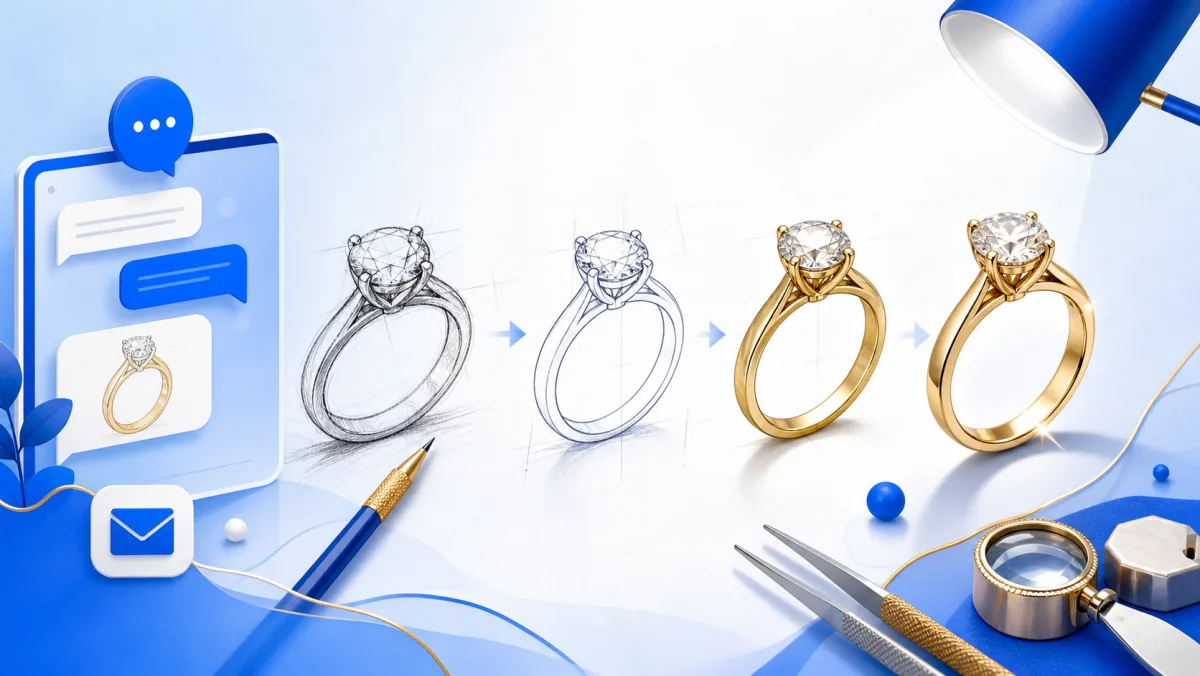
Video of the transformation from sketch to product (before and after), production moments from the workshop, the story of renewing old jewelry and customer narrative ("he wanted this detail, we did it like this"). The common feature of these contents is that they produce the thought in the viewer that "what I have in mind can also be done" - the demand for special design arises from this moment.
How to target special design in advertising?
Custom design searches are small in volume but very high in intent. Therefore, it is more profitable to focus on narrow and intentional searches rather than broad targeting.
Search and social media play different roles
In the search ad, direct terms such as "custom design ring", "personalized necklace", "ring made to order" are targeted and the request form is entered. In social media, content, not targeting, is decisive: process videos create demand, while retargeting moves the viewer to the form. Using two channels with the same message weakens both.
How should an advance, revision and cancellation policy be written?
The source of disagreement in custom production is almost always details that were not discussed from the beginning. A written, simple policy puts the customer at ease and protects you.
| subject | It should be clear |
|---|---|
| advance rate | What percentage and when to take it? |
| Right of revision | How many changes are free at the sketch stage |
| After production starts | Which changes are possible and which are not? |
| Cancel | At what stage, how much of the advance will be refunded? |
| Delivery time | In days, what happens in case of delay |
| Size change | Is it free after delivery? |
What should be done after delivery?
Custom design is the jeweler's most powerful source of content and recommendations — because the customer is emotionally invested. The moment of delivery is photographed (with permission), comments are requested a few days later and the story of the product is shared. A single custom design job, when explained correctly, can become the source of several new demands.
This is consistent with industry data: jewelry repeat purchase rate is around 38%, above the overall e-commerce average (~28.5%). Custom design customers are the group with the highest rate; The person who has an engagement ring made is also a natural buyer for wedding rings, anniversary gifts and birthday jewelry.
What are the most common mistakes in custom design?
Never announce the service
The store that makes special designs but does not mention this anywhere keeps its most profitable service invisible. Sharing process content a few times a month alone will start an influx of demand.
Giving no anchor on price
The answer "it depends on the design" is correct but will drive away customers when left alone. When the range, item logic, and finalization step are given together, uncertainty becomes manageable.
Skipping the sketch phase
Starting production without an approved image produces delivery disputes. The sketch both makes the customer feel safe and prevents the "I didn't want it that way" argument from the beginning.
How should the long decision cycle change lead strategy?
Purchasing specially designed jewelery does not happen in a single session. 68% of buyers compare 3 or more brands or workshops before making a decision, and 64% start researching at least 3 months before purchasing (Source: The Knot 2024 Jewelry & Engagement Study). This means a single visit won't lead to conversions; The real work starts after the first contact.
Transition from one-touch form to multi-step tracking
A visitor who fills out the request form and waits for an answer but does not make a decision immediately should not be considered lost. This person is still in the comparison phase. Once the email address or phone number is obtained, short reminders sent at weekly intervals — a video of the process, a similar completed design, a description of the price range — keep the person warm until the moment of decision.
The frequency of follow-up should vary over time: weekly contact for the first month makes sense because the buyer is still actively comparing. Starting from the second month, the frequency can be reduced to once every two weeks; Otherwise, a persistent brand impression will be created, which may have the opposite effect and drive the candidate away.
Why retargeting is mandatory and not optional in this product
A single ad impression in a three-month research window means nothing. Retargeting people on social media who visited the site or request form but did not complete it means re-showing the same process content in different formats. In the eyes of a buyer who makes a competitor comparison, the last brand he sees remains in an advantageous position.
Retargeting should not be limited to a single channel: the person who opened and did not complete the form can be shown a short reminder via WhatsApp on the same day, and a completed design video can be shown on social media a few days later. Using channels to complement each other rather than sequentially is more effective than repeating the same message on a single channel.
The concrete impact of personalization on conversion
This is where a personalized offer or pre-design presentation makes the difference: follow-up messages with a personalized draft or quote increase the conversion rate by an average of 28% and also increase the average basket amount by 20% (Source: Deloitte Global Powers of Luxury Goods, personalization impact section). In other words, the second contact should not be a generic reminder, but a concrete suggestion based on the measurement/preference information received in the first meeting.
In practice, personalization does not require a complex system: the stone colour, budget range or inspiration image specified in the request form can be used as a direct reference in the follow-up email. “We have a draft for you” creates a much stronger appeal than looking at a generic catalogue.
What information should not be left out for the buyer making the comparison?
A person comparing 3 or more workshops asks the same three questions in each: how long does the process take, what does the price depend on, what is the right of cancellation/revision. The workshop that does not provide these three answers clearly at the first contact is eliminated in the next comparison — because the buyer has already found this information elsewhere.
In practice, this means an automatically sent informational email immediately after the request form: process steps, estimated time and sample price range on one page. The candidate who does not receive this e-mail spends the remainder of the three-month research process on the rival companies' site.
How to separate leads by decision stage
Not every request is of the same urgency. A candidate who has stated a budget and a date and responded quickly is close to purchasing, and it is right to approach this person directly by phone or by face-to-face appointment. The person who just watches a process video and leaves without filling out the form is still in the research phase and content feeding, not direct sales, is appropriate.
Sending the same sales message to all candidates without making this distinction may force those who are ready to go too early and scare those who are in the research phase with an early offer. A simple labeling — “hot,” “warm,” “cold” — is enough to set the tone and frequency of the follow-up message just right.
Which metric to track in a quarterly period?
It is misleading to give credit to a single touch in the long decision cycle. Which channel the first contact came from (call, social media, referral) and how many contacts occurred before the purchase should be tracked with a simple CRM note; otherwise it becomes invisible which channel actually works.
This follow-up is necessary not only to correctly allocate the marketing budget, but also for the sales team to intervene at the right moment: a candidate who is still undecided by the third or fourth contact deserves a personal call rather than an automated email.
Why patience becomes a competitive advantage in the long run
Most small workshops forget about the candidate when there is no response within a few days and spend their budget only on bringing new demand. However, the person who filled out the form three months ago and did not purchase that day is not lost yet; A significant portion of the candidates who are reminded at correct intervals return at the end of the process.
That's why setting up a follow-up system is a cheaper and more reliable source of growth than bringing in new demand: you already have someone who has shown interest, all that's missing is the right reminder at the right time.
As a result, the real competition in couture jewelery is not won by who gets the first form faster, but by who follows the candidate more consistently and personally throughout the three-month period.
real cases
Our Client Results in This Area
Meta Ads and Google Ads management for an Uzbek container terminal and warehousing operator. Work has just begun.
- Status
- Just started
- Scope
- Meta Ads + Google Ads
- Facilities
- Angren terminal + Andijan warehouse
Digital marketing for a Tashkent-based IVF and women's health center
- Leads · on half the budget
- Increased
- Scope
- Website, SEO/GEO, social ads, CRM, brand consulting
Google Ads management for Turkey's sole authorized representative for West Africa cargo tracking certificates
- Target Markets
- Turkey, Europe, Americas
- Sector
- B2B Logistics
- Campaign Type
- Google Ads
checklist
- Is the custom design service clearly stated on the profile and site?
- Are there budget and date fields in the request form?
- Are the price range and pen logic explained?
- Are the process steps shared in writing?
- Are advance, revision and cancellation conditions clear?
- Is the story of the delivered work shared (with permission)?
Related articles
How does 101digital collect custom design requests?
We create a special design request form, process description, content plan and advertisement for intentional searches as a single system for jewelers. The target is not interest, but advance orders. → Digital marketing services
It is almost always because a search is not met: the customer could not find what he was looking for in the window or wants to change a detail. Marketing does not create new desires, it makes existing ones visible.
Give a three-part answer: the price range of similar works, the items that determine the price (gram, carat, stone, workmanship) and at what step the exact price will be clarified. Just saying "it depends" will drive the customer away.
Yes. The advance is both a financial hedge and a screening tool; The customer who gives the advance completes the process. The rate and return condition must be stated in writing from the beginning.
Not the finished product, but the process: video of the transformation from sketch to product, workshop moments, renewal of old jewelry and customer narrative. These create the thought in the viewer that "what I have in mind can be done too."
Realistically. Being short and late is the mistake that produces the most complaints in custom design — especially for fixed-date events such as engagements and weddings. It is always better to state the actual time and deliver early.