Most of the time, what stops the buyer in jewelry is not the price, but the "real" doubt — and every signal that reduces this doubt directly turns into a sale. In a high-cost, infrequent and difficult-to-return purchase, the customer evaluates the seller, not the product. This article covers how to display setting and certification information, why price transparency increases sales, how to collect comments, and how to establish online trust signals.
Short answer
Trust in the jeweler does not arise from the quality of the product, but from the number of information that the buyer can verify on his own. Because the customer cannot measure the purity of the metal visually; The only thing he can measure is how much about himself the store demonstrably puts in front of him. Visible hallmark, price per gram and labor, written exchange condition and answered comments — if all four are present, the buyer has made up his mind before asking the price.
What is the real concern of the jewelry buyer?
The question in the mind of the customer standing in the jewelry store window is not "is it expensive?", but "am I being deceived?" This concern falls under three headings: is the metal really of the stated carat, is the stone natural, and does the price I pay correspond to the true value of the work. If the seller starts talking without answering these three questions, the customer will say "let me look elsewhere" as soon as he hears the price.
Anxiety grows with purchase amount
No one asks for certification on a twenty-dollar accessory; When it comes to engagement rings, even the calmest customer becomes cautious. Therefore, the trust content is adjusted according to the product segment: in high-basket categories, setting, stone and warranty information come to the fore, while in the middle segment, design and price logic are sufficient.
Price pressure after 2026 increased concern
With the removal of the VAT exemption on the sale of jewelery and semi-finished products as of January 1, 2026, prices have moved up throughout the sector. When the price increases, the customer's sensitivity to "am I being deceived" also increases. The best defense during this period is not discounting, but clearly showing how the price is formed. (Source: NORMA.uz / buxgalter.uz)
How should settings and certificate information be displayed?
Carat knowledge is the jeweler's most powerful and least used confidence tool. Most stores will say this when asked; However, it becomes persuasive when shown without being asked. The equivalents of milyem (proba) with the international adjustment system are as follows:
| Milyem (proba) | carat | golden ratio | Typical usage |
|---|---|---|---|
| 375 | 9K | 37.5% | Economical segment, durable |
| 585 | 14K | 58.5% | Daily use, most common |
| 750 | 18K | 75% | Stone and designer products |
| 916 | 22K | 91.6% | Traditional, wedding jewelry |
| 999 | 24K | 99.9% | Investment, bullion/coin |
This painting is not on display on label and in speech Use: instead of saying «585» to the customer, saying «585, that is 58.5% gold» is a one-sentence addition, but it closes the question on the other side. This is the only table the sales team needs to memorize; All other trust instruments are built on this.
Where and how is it displayed?
In three places: on the product label (visibly), in the description next to the product photo, and by telling the customer at the time of sale. Adding setting information to every product post on social media reduces questions and shows the seriousness of the store. Sharing a close-up photo of the stamp is a powerful form of content on its own — because it bridges the gap between “we tell” and “we show.”
Why does showing how the price is formed increase sales?
In jewelry, the price is not a single number, but the sum of several items. When the customer does not know these items, he thinks the price is arbitrary; When he knows, he is able to make comparisons — and the customer who makes the right comparison often chooses the obvious, not the cheap one.
| pencil | What determines | How to explain to the customer |
|---|---|---|
| gram weight | amount of metal | "This model is X grams" |
| Setting | purity of metal | "585 carat, meaning 58.5% gold" |
| Daily metal price | market value | "The price depends on the current gram price" |
| workmanship | Labor and design | "Handcrafting / casting difference" |
| stone | Type, size, quality | "Natural / synthetic, how many" |
The seller who can name the five items individually does not have to defend the price, he just explains it. The practical application is this: instead of quoting the figure in one piece when bidding Separate grams and labor. If the customer is going to make a comparison, he will do it anyway; It is much more likely that the comparison with the disaggregated price will come out in your favor.
Transparency replaces discounting
A seller who can answer the question "Why this price?" with five items can persuade without making a discount. The opposite is also true: a store that does not explain its pricing logic is forced to bargain and sell at a discount — which together drives down margins and brand perception.
How are comments collected and where are they displayed?
In the jewelery store, a review is the digital equivalent of a friend's recommendation. The most decisive variable of the collection is not the text but the timing.
| moment | Should it be requested? | From where |
|---|---|---|
| At the time of sale, in store | weak | Gives a feeling of rush and pressure |
| 1-2 days after delivery | Yes, the best moment | The product is installed, the satisfaction is fresh |
| After the gift is given | yes | The reaction of the other party has been seen |
| Free maintenance/after-cleaning | yes | Unexpected service generates goodwill |
| After the problem is resolved | yes | The most persuasive comment type |
The main use of the table is to set up a calendar: an automatic reminder a day or two after the sale, and a list of customers who have received maintenance services at the end of the month. Comments accumulate when they are systematized, not when remembered. — A store that collects five reviews a month will be visibly differentiated from its competitors on the same street within six months.
Where should it be shown?
The place where the comment is collected and where it is displayed does not have to be the same. Google and 2GIS profiles work for search visibility, Instagram highlights work for the browsing user. Making the same comment visible in both places convinces two buyers at different stages.
How to respond to a negative comment?
A single negative review, when answered well, can be more persuasive to the brand than five positive reviews; because it shows what will happen when a problem occurs. Leaving it unanswered means silently accepting the claim.
Four step answer
Be quick (24-48 hours), start with calm, non-defensive language, suggest a concrete action (“let us call you,” “let us check the product”) and move the conversation to the private. Getting into an argument, denying the customer, or revealing details publicly harms more than just the person reading the negative review.
It is another problem that all the answers are written in the same pattern; the reader sees it as a text template and does not read it one by one. Addressing the details of the complaint itself in each reply — which product, which date, which transaction — shows that the reply was actually read and increases the value of all replies in the profile.
Why does brand story and workshop content work?
Jewelry is an intangible product when the production process is not visible; Its value is understood when seen. The workshop content is therefore a stronger instrument of trust than advertising: the preparation of the mould, the setting of the stone, the moment of polishing – these are also the description of the price.
The answer to the question who does it?
The appearance of the master's face and name transforms the store from an anonymous storefront into a recognized business. Simple information such as how many years he has been doing this job and what techniques he is an expert in create the buyer's judgment that "they know their business" - and this judgment significantly reduces price bargaining.
Workshop content also has a measurable side effect: between two posts showing the same product, the one showing the production moment is watched longer and brings more questions via direct message. Therefore, the workshop video is not a «cultural content», it is sales content and should be taken as seriously as advertising in the content calendar. (Source: 101digital's application experience)
How should the warranty, return and exchange policy be written?
Unwritten policy produces uncertainty, not trust. The customer wants to know the answer to the question "what will happen if there is a problem" before purchasing; When he doesn't know, he postpones the purchase.
| subject | It should be clear | From where |
|---|---|---|
| Adjustment warranty | The specified setting is guaranteed | Meets primary concern |
| Exchange condition | In what time and with what difference? | Reduces purchasing risk |
| Size change | Is ring size free? | Makes buying gifts easier |
| Repair and maintenance | Is it free and for how long? | Builds long relationship |
| Invoice and document | Given with every sale | Indicator of seriousness |
These five lines are not included in a separate «terms» page. where the customer decides Put it: on the label, in the offer message and in the product description. No one remembers the verbal guarantee; What is written binds the store even after the sale, and this binding is exactly what creates trust.
How to establish trust signals online?
Online conversion rates for jewelry are naturally low — around 0.95-1.46% in industry benchmarks — because the product is expensive and difficult to pick up untouched. What increases this rate is not more traffic, but more trust signals. (Source: 2026 jewelery marketing benchmarks)
What should be included on the page
Real store address and map, working hours, phone and Telegram link, setting information, warranty and exchange condition, real customer reviews and photos taken from the store (not stock images). The absence of these may seem like small deficiencies one by one, but in total they leave the question "who is this person, is he trustworthy?" unanswered.
How is trust measured?
Although trust may seem abstract, its indicators are concrete. Four things that can be measured: monthly number of new reviews and average rating, message-to-store visit conversion rate, repeat purchase rate, and bargain request frequency. The last one is particularly instructive: as price logic and setting information become clearer, the demand for bargaining decreases.
Repurchase is particularly meaningful here; In the sector, this rate is approximately 38%, above the general e-commerce average (~28.5%). In other words, in a trusted jeweler, customers become a cheaper source of income than finding new customers. (Source: 2026 jewelery marketing benchmarks)
For which product is certification really required?
The word «Certificate» does not mean the same thing for every product and it is not required for every product. Showing unnecessary documents to the buyer creates confusion, not trust; Failure to show the required document stops the sale directly. The distinction is actually simple: the purity of the metal is proven by the stamp, the identity of the stone is proven by the document.
The stamp under stone speaks, not the certificate
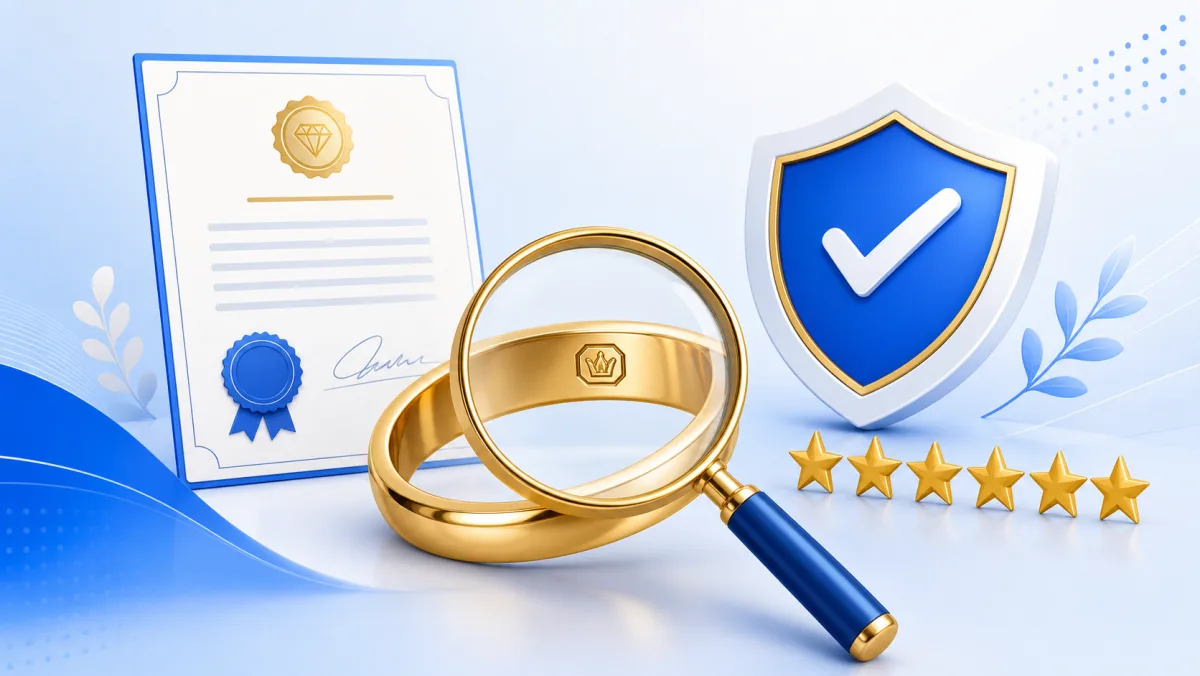
The only thing the customer asks about a stoneless bracelet or wedding ring is the setting, and the answer to this is the stamp on the product. Here, it is much more convincing to make the stamp visible—show it with a magnifying glass and match it with the label—rather than producing an additional document. Where paper proliferates, the recipient begins to focus not on the document but on why the document is needed.
For diamonds, the document is a part of the product.
With stone products, the situation is reversed: since size, color and clarity cannot be verified by eye, the document becomes an integral part of the product. A stone product sold without documentation becomes controversial as soon as the buyer consults a second jeweler and the seller loses that argument. If synthetic stone is used, writing this clearly will cause much less harm than finding out later.
How should the document be delivered to the customer?
The document is delivered not as a piece of paper thrown into a bag, but as a moment of the sale: it is explained to the customer, the two or three items on it are shown one by one, and the photo is sent to him. This three-minute job also ensures that the customer who says "I lost it" comes back to the store after months. The store that gives the document without explaining it is practically considered to have never given the document.
How do redemption and redemption conditions affect trust?
The person who buys jewelry also thinks about the possibility of selling it in the future; Therefore, the question "Would you buy it back?" is not actually a price question, but a trust test. The store that leaves the answer unclear thinks that it is the product that has become suspicious, but it is itself that has become suspicious.
Tell me where the buyback difference comes from
It is normal for the amount paid in the buyback to be below the sales price; The problem is not in the number, but in not disclosing that number. A seller who states at the time of sale that labor is not taken into account in the buyback and that the price is based on the current gram value will end the debate that will occur years later.
Trade in is a better offer than cash out
Most of the time, the customer is not looking for money, but a new product. Offering better conditions for exchange both keeps the customer in the store and returns the old product without additional stock costs. Having this requirement in one sentence and in writing is much more effective than a long policy text.
Keep the invoice and label
The most common problem with repurchase is lack of documentation. Saying "keep this invoice, it will be useful when you buy it back" at the time of sale is a small sentence, but it makes the buyer feel that there is a continuation of the business. Sending a photo of the invoice to the customer via message completely eliminates this risk.
How to plan a trust budget and the first 90 days?
Trust building is not a campaign, it is a sequential program. When the order is broken, money is spent, but the result is immeasurable: a store that opens an advertisement when the setting and price information is not on the page does not have any material to persuade the visitor.
| Period | work to be done | Metric to measure |
|---|---|---|
| 0-30 days | Setting, gram and price logic contents; writing the warranty and exchange condition; taking photo from real product | Product ratio with setting information visible |
| 30-60 days | Filling out Google and 2GIS profiles; routine for asking for post-sale reviews; response pattern to negative comment | Monthly number of new comments and average score |
| 60-90 days | Workshop and master contents; page for local search; first measurable ad | Conversion rate from message to store visit |
View the table not as a to-do list, like a row of doors Read: You cannot move on to the next period until the previous period's metric becomes measurable. The first thirty days can be ad-free, and that's no loss — the setting, price, and warranty content established during that period is what makes advertising cheaper for the next two months.
What items does the money go to in the first three months?
For a small jeweler, the first three months' expenses come down to two items: a digital display page and visibility in local search. In 101digital pricing, a landing page costs $300, SEO work costs $350 per month, and SMM management costs $250 per month; Instead of starting all three in the first month, it is better to start with the page and add it as the measurements come. (Source: 101digital 2026 service price list)
When is the decision to increase the budget made?
The budget is increased not because the number of visits increases, but because the number of people converting messages to store visits increases. Increasing the advertising budget when this transition is not working will produce no results other than losing more in the same place. For market size and digital behavior data Uzbekistan Digital Marketing Statistics 2026 Our report can be a starting point.
What are the most common mistakes in building trust?
Fake or purchased review
Overly complimentary comments that are similar to each other will be noticed by the reader and when detected, the profile will be damaged. The gain is short, the loss is permanent — and it reduces the credibility of real reviews.
Leaving setting and price information as "if they ask, we will tell you"
Information given without asking creates trust, information given when asked is only the answer. When setting, gram and price logic are standard parts of the content, the customer comes to the store already convinced.
Images that show the product differently from the store
An overly edited photo or stock image taken from the internet will disappoint the customer who comes to the store. In real light, the image taken from the actual product may appear less bright, but it significantly increases after-sales satisfaction and comments.
real cases
Our Client Results in This Area
Meta Ads and Google Ads management for an Uzbek container terminal and warehousing operator. Work has just begun.
Digital marketing for a Tashkent-based IVF and women's health center
Google Ads management for Turkey's sole authorized representative for West Africa cargo tracking certificates
checklist
- Is the setting information visible on the product label and in the posts?
- Is it explained how the price is formed (gram + carat + workmanship + stone)?
- Is a comment request sent 1-2 days after each sale?
- Are negative comments responded to within 48 hours?
- Are the warranty, exchange and size change conditions written?
- Are the images taken from the actual product?
Related articles
How does 101digital build trust?
We establish setting and price transparency contents, comment collection routine, Google/2GIS profile management and trust-oriented page setup as a single system for jewelers. The goal is not more impressions, but the product sold without bargaining. → Digital marketing services
Not the price, but the doubt of reality: is the metal of the specified carat, is the stone natural, does the price correspond to the real value. The store that answers these three questions without being asked comes first.
In three places: on the product label, in the description of the product photo, and verbally at the time of sale. A close-up photo of the hallmark alone is a powerful source of confidence.
In the Milyem system, 585 means that the product contains 58.5% gold and corresponds to 14 carats. It is the most commonly preferred setting in daily use; 750 is 18 carats, that is, 75% gold.
On the contrary, it makes it easier. The price expressed in terms of grams, carats, current metal prices, labor and stone items does not seem arbitrary; Transparency reduces the demand for bargaining and enables persuasion without discounting.
Not at the time of sale, but 1-2 days after delivery — when the product is installed and the satisfaction is fresh. After a gift is given, after free care, and after a problem is solved are also powerful moments.