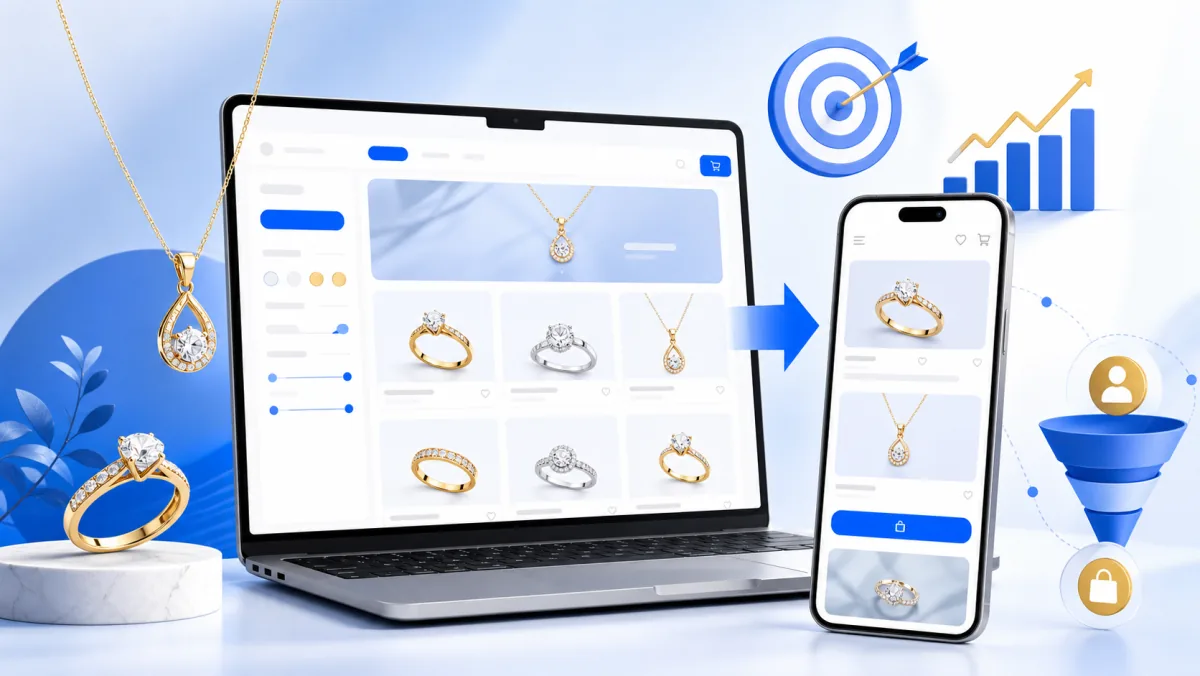
A jeweler's website does not have to be an online store; Its main job is to prepare the trust and decision before the customer comes to the store. For jewelry, purchasing is often completed in-store, but research is done online — and the site is where that research stops. This article covers catalog structure, photo standard, price display decision, mandatory pages, data management and cost.
What is the main job of the jewelery site?
The question that needs to be answered before the site is established is not "what will we sell", but "which question will we answer". There are three things that the customer looks for in jewelry on the site: is this store real, what can I buy with the budget I have, and does the model I am looking for exist here?
It does what Instagram can't
Social media is powerful for discovery, but bad as an archive: no one can find the model shared three months ago. A catalog site fills this gap — products can be sorted by category, price range, and setting. In addition, the site is the only digital asset you have against risks such as social media account closure.
Condition to appear in search engine
"Engagement ring prices" or "[district] Appearing organically in searches such as "jeweller" is only possible with indexable pages. Social media posts do not appear in these searches; category and service pages appear.
How should the catalog be structured?
Catalog architecture determines both customer discovery speed and search engine visibility. Three axes work in the jewelry store: product type, intended use, and price/setting.
| axis | example | What does it do? |
|---|---|---|
| Product type | ring, necklace, earring, bracelet, set | Main navigation; most used way |
| Purpose/situation | Engagement, wedding ring, gift, diary | Captures malicious calls |
| sterling/metal | 585, 750, silver | The conscious buyer looks for this filter |
| Price range | budget bands | Gift recipient's first filter |
| stone | With stone, without stone, natural/synthetic | Determinant in the high segment |
"Engagement ring" deserves a separate page
The highest basket and most searched category should not remain a filter within the catalogue. A section with its own page, its own description, size guide and appointment link can be used as a landing page in both organic search and advertising.
How to establish product photography standard?
On the jewelry site, the photo is the product itself. A catalog shot in bad light and with different backgrounds looks cheap, no matter how good the products actually are.
One standard, the same for every product
Same background, same lighting, same angle and same framing. This consistency creates professional integrity when looking at the catalog page and facilitates comparison between products. At least three images are recommended: straight shot, angle shot, and mounted.
Video explains the size
The actual size of a ring cannot be seen in the photo and this is the most frequently asked question. A few seconds of rotating product video or handheld demonstration both answers this question and shows the shine of the stone—which is never visible in the static image.
Should the price be displayed and how?
This is the decision that jewelers hesitate the most because the price of gold is variable. However, a priceless catalog also eliminates serious buyers and fills the incoming messages with requests that do not fit the budget.
| Approach | Advantage | Disadvantage | Who is it suitable for? |
|---|---|---|---|
| net price | Highest trust and conversion | Frequent updates required | Fixed price, ready-made product |
| Price range | Provides elimination, low update burden | no certainty | The right middle ground for most jewelers |
| Gram + craftsmanship logic | Transparency stays current | Customer must calculate | Gold-based products |
| no price | Flexibility | Unqualified demand, insecurity | Only in special design |
State variability clearly
A single sentence such as "Prices are calculated according to the current gram price" both tells the truth and manages the expectation. An old price displayed without this sentence will disappoint customers in the store — and this is more harmful than not displaying a price.
Which pages are a must?
Trust on the jeweler's site is established with the page list. When the following are missing, the visitor leaves the "who is this" question unanswered and exits.
| Page | Content | From where |
|---|---|---|
| home page | Featured categories, store, trust signals | redirect |
| Category pages | Filtered product list | Organic traffic and navigation |
| Product page | Image, setting, gram, price, stock, contact | decision point |
| Store / contact | Address, map, time, phone, Telegram | Makes the visit possible |
| About us | How many years, master, workshop, adjustment policy | core of trust |
| special design | Process, examples, request form | Highest margin service |
| Warranty / exchange | Adjustment warranty, size change, return | Reduces risk |
| Blog/guide | What is adjustment, how to take measurements, maintenance | Traffic from information searches |
Why are site speed and mobile decisive?
Jewelry sites are visual-heavy by nature, and this is the most common source of speed issues. Approximately 89% of internet usage in Uzbekistan is mobile; In jewelry e-commerce, approximately 74% of traffic comes from mobile devices.
Image compression is the biggest single gain
Directly loaded high-resolution product photos slow down the catalog page more than the ad or search visitor would expect. Compression and delayed loading provide the biggest speed improvement on most jewelry sites at once.
How should product data be managed?
In the jewelery store, the catalog differs from other retail sectors: most items are unique and are finished when sold. This makes data management critical.
Fields that should be included in every product
Product code, category, setting, gram, stone information, size, price or range, stock status and which store it is in. When these fields are standard, filtering works and it becomes possible to communicate on social media by saying "product with this code".
The sold product must be removed on the same day
A product that remains on the site but has been sold wastes advertising budget and creates disappointment in the customer. If automatic stock linking is not possible, a daily control routine should be defined — this is an operational decision, not a technical one.
How does the site, Instagram and Telegram merge?
The three channels are not competitors, but links in the chain: Instagram gets people discovered, Telegram gets people talking, and the site archives and convinces. If this chain is not established, each channel will remain weak individually.
Practical connections
The only link in the Instagram profile should go to the site or catalogue; There should be a one-touch Telegram link on every product page; Every product shared on the Telegram channel must be linked to the product page on the site. Once these three connections are established, the same content runs across all three channels.
Which product is sold online and which in store?
There are three things that determine online salability: price, metric risk, and emotional weight. As price rises and size becomes more important, purchasing shifts to the store.
| Product | online sales | From where | right target |
|---|---|---|---|
| Fine necklace, earrings, gift | suitable | Low price, no measurement risk | direct sales |
| bracelet | partially | Size is important but predictable | Sales + reservation |
| Ring (daily) | partially | Measurement risk is high | Reservation |
| engagement/wedding ring | weak | High price, must try | Store visit |
| bridal team | weak | Very high amount, family decision | appointment |
| special design | weak | It requires process | Request form |
Determine the purpose by product
Putting an “add to cart” button for every product on the same site will reduce conversion at higher end levels — because the customer is forced into a step they are not ready for. The right setup offers a different next step depending on the product type: purchase for a gift, reservation for a ring, appointment for an engagement.
What is O2O and how does it work in a jewelery store?
O2O (online to store), not the online outlet orientation is used as a layer. This approach in the jewelery store is the model that best suits the reality of the category: the customer finds the model on the internet, tries it on in the store, and buys it there.
three step chain
The first step is discovery: the product appears online and the pricing logic is understood. The second step is commitment: the customer says “reserve this model for me” — a small but powerful step that almost guarantees a visit. The third step is the greeting: a staff member in the store who knows which model the person is asking about. The weakest link in this chain is usually the third one: a store that works well on the online side loses its impact when it does not recognize the incoming customer.
How to set up a “see in store” booking model?
Booking is the jeweler's most valuable button on the online side because it generates commitment without the psychological burden of purchasing. The customer doesn't pay, but he gets one step closer to making a decision.
Keep it simple: three fields is enough
Product (automatic), name and contact, preferred day. It cannot be overfilled. Once the reservation is received, there are two things that are critical: a quick confirmation message and the fact that the product is actually reserved in the store. If the latter is not done, reservation becomes a promise that loses trust rather than a tool that builds trust.
How much does it cost and take?
| Option | Home | Duration | Who is it suitable for? |
|---|---|---|---|
| Single landing page | from $300 | days | For a single category or campaign |
| catalog site | from $800 | weeks | Store with a variety of products |
| Advanced catalog + filter + order | from $2,500 | weeks-months | Many products, many branches, online sales |
| Traffic (Google Ads) | $400/month | Continuous | After the site is established |
| SEO | $350/month | Continuous | If there is an organic growth target |
The most common budget mistake is to spend all the resources on the site and not allocate any resources to traffic. A catalog without visitors will not generate sales, no matter how well designed it is.
What should be measured on site?
"Number of sales" alone on a jewelry store site is misleading because most of the time the site's job is to bring people into the store.
| metric | What does it tell? |
|---|---|
| Category → product migration | Does the catalog structure work? |
| Message/call from product page | real demand |
| Directions click | Store visit intention |
| mobile speed | Lost visitor |
| Most viewed products | Stock and content decision |
| Search box queries | What's missing from the catalog? |
What are the most common mistakes made on jewelry sites?
Not updating the catalog
A site where the same products have been available for months gives the visitor a message saying "this site is not tracked". The catalog is a living entity with the portfolio; A catalog that is not updated is like a showcase that is not updated.
Connecting communication only to the form
Mobile users do not like filling out forms. One-touch opening of direct calls, Telegram and WhatsApp links significantly increases the number of requests from the same page.
Skipping tuning and gram information
If there is no setting and gram on the product page, it means the page is missing for the serious buyer; because these two information are the basis of price and quality. Without them, the catalog turns into an album of beautiful photographs but undecidable.
Why should the settings table be included in the catalogue?
Short answer: when setting information is visible and comparable, the buyer understands the product before questioning the price. Just writing the number on the product card is not enough; It is necessary to explain somewhere in the catalog how to read the adjustment system.
What do the setting numbers actually indicate?
The thousandth mark used in Türkiye and surrounding markets indicates the proportion of pure gold in the alloy; Carat is the expression of the same ratio over 24. The two tell the same information at different scales, and the customer is usually familiar with only one of the two.
| thousandth stamp | carat equivalent | Pure gold rate |
|---|---|---|
| 375 | 9K | 37.5% |
| 585 | 14K | 58.5% |
| 750 | 18K | 75% |
| 916 | 22K | 91.6% |
| 999 | 24K | 99.9% |
When this five-line table is added anywhere on the catalog page, visitors using the settings filter will read the figure along with its carat equivalent and will not need to return to the product page. (Source: International karat conversion standard)
Should the table be on the product card or on a separate page?
It is best to have it in two places: in the product card with the relevant setting line highlighted, or in the entire table in the information or FAQ section of the catalogue. Thus, both the visitor who makes a quick decision and the visitor accesses the same data at different speeds.
Technical data in tabular format is the type that search engines prefer to quote directly; the same information written in plain text does not carry this advantage. (Source: Search engine featured snippet formatting practice)
Another benefit of the carat table is to prevent complaints: the customer who sees the figure in advance is less likely to ask the question "is this really 14 carat" in the store, because he has already made the comparison himself.
How to present large product images on mobile without causing problems?
It is not possible to compromise on visual quality in the jewelry catalogue, because the shine of the stone and the texture of the metal can only be seen in high resolution. The problem is to deliver this quality on the mobile screen without losing speed.
Why is the zoom feature indispensable?
The stone setting or edge work of a ring on the phone screen cannot be selected without touch-to-zoom. This feature requires a technical infrastructure that does not lose the original clarity when the user enlarges the image with two fingers or double-tap.
In a catalog without a zoom feature, the visitor only evaluates the product with a small preview and leaves the page with doubts about quality; That's a customer lost before coming into the store.
How to balance image size and upload speed?
The right approach is not a single file size, but a layered presentation: the visitor who first opens the catalog is shown a small and fast-loading preview, and the high-resolution image comes into play when entering the product page. Modern image formats significantly reduce file size without visible loss of quality. (Source: WebP/AVIF modern visual format comparison)
If five or six images of the same product taken from different angles are loaded simultaneously on a single page, the page turns into a seconds-long wait on the mobile connection; However, loading only the currently visible image significantly shortens this time. (Source: delayed visual loading performance practice)
It is the responsibility of the developer, not the designer, to strike this balance; What the jeweler needs to do is to directly ask the agency from which he received the offer, "Can the images be zoomed in, are they loaded with a delay?"
How many images should be uploaded and in what order?
When the product page opens, the cover image should load first, then other angles as the user scrolls; No page should download all images at the same time. This sorting shortens the time it takes for the page to become "usable".
On the category page, a single small preview for each product is sufficient; Using large resolution images in the category list is one of the most common mistakes that makes that page unnecessarily heavy.
As a result, visual quality and page speed are not rivals for each other in the jeweler's catalogue; When the right order and the right format are chosen, the visitor will see the detail and not wait.
real cases
Our Client Results in This Area
Meta Ads and Google Ads management for an Uzbek container terminal and warehousing operator. Work has just begun.
- Status
- Just started
- Scope
- Meta Ads + Google Ads
- Facilities
- Angren terminal + Andijan warehouse
Digital marketing for a Tashkent-based IVF and women's health center
- Leads · on half the budget
- Increased
- Scope
- Website, SEO/GEO, social ads, CRM, brand consulting
Google Ads management for Turkey's sole authorized representative for West Africa cargo tracking certificates
- Target Markets
- Turkey, Europe, Americas
- Sector
- B2B Logistics
- Campaign Type
- Google Ads
checklist
- Can the catalog product type, purpose and setting axes be navigated?
- Does each product have setting, gram, size and stock information?
- Is the price or price logic shown?
- Is there a separate page for engagement rings?
- Does the page open quickly on the phone?
- Is the product sold removed on the same day?
Related articles
How does 101digital set up its catalog site?
We establish the catalog architecture, product data structure, photo standard and store orientation measurement as a single system for jewelers. The goal is not a beautiful site, but a decision-making catalogue. → Digital marketing services
Instagram is strong for discovery but weak as an archive: no one can find the model from three months ago. The site stores the catalogue, it appears in the search engine and is the only digital asset you have left even if your account is closed.
For most jewelers, the right middle ground is the price range or “gram + labor” mentality. A priceless catalog also eliminates serious buyers and fills the incoming messages with requests that do not fit the budget.
Product type (ring, necklace…), purpose (engagement, gift, daily), setting (585, 750), price range and stone condition. The conscious buyer specifically looks for the setting and price filter.
One standard: same background, same light, same angle. At least three images (straight, angled, mounted) and a short video are recommended; The video shows the scale and brightness that the photo cannot convey.
A single landing page starts at $300, a catalog site starts at $800, and an advanced catalog with filters and orders starts at $2,500. The most common mistake is to spend the entire budget on the site and not allocate any for traffic.