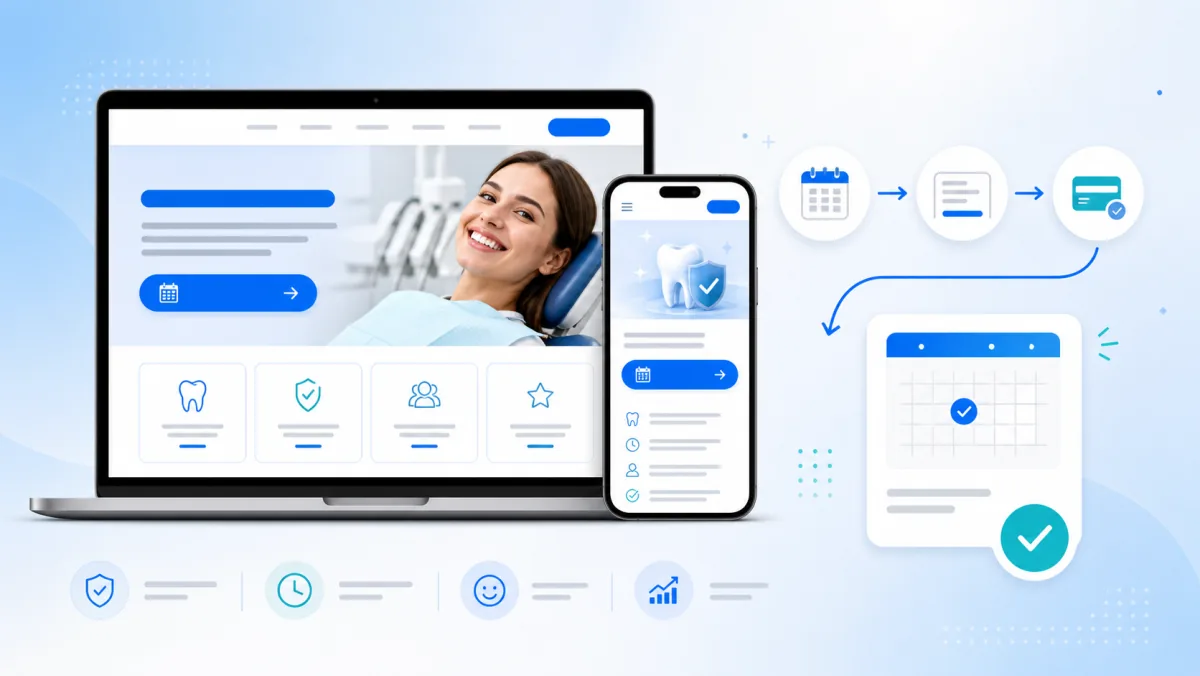
The job of a dental clinic website is not to look nice, but to convert visitors into appointments. All traffic from advertising, search and social media flows to the site; If the site is slow, confusing, or the appointment step is unclear, all that earned attention goes to waste. In this article, we explain what a dental site that turns into patients should have.
Short answer
The dental clinic site that turns a visitor into an appointment relies on four things: fast startup on mobile, Proof of trust visible in the first second, Appointment action accessible with a single click on every page and separate page for each service. The beauty of design does not replace these four; The site transforms not because it is beautiful, but because it quickly answers the questions in the patient's mind: "Is it reliable?" and "How do I make an appointment?" These four items must be completed before the advertising budget is spent.
Why is the site a conversion center?
Google Ads, Instagram, map and referral — all eventually bring the patient to the site. The site is where that interest turns (or fades) into dating. Therefore, the site should be designed like the hardest working salesperson of the clinic, not a "digital business card".
Why speed and mobile-friendliness determine conversion
Most patients open the site from their phone. A site that does not load in 3 seconds loses a significant portion of the visitor before they even see the content. Mobile-readable text, easy-to-touch buttons and fast loading; It is the invisible but most decisive basis of transformation.
What trust elements should be on the site?
Tooth is a matter of trust; The site should provide this in the first second: physician names, specialty and photos, licensing/association information, real patient reviews, clinic images, and before/after (approved). These elements create the visitor's feeling of "I can trust this place."
What should the clear appointment flow be like?
The most critical point: the visitor must understand in seconds what to do. A visible action on every page (Call / WhatsApp / Make an Appointment), one-step and short form, clickable phone and map. The simpler the appointment step, the higher the conversion; Long forms that require unnecessary space drive away the patient.
Factors that determine transformation
| element | Why is it important? | What happens if it is missing? |
|---|---|---|
| Mobile compatibility + speed | In Uzbekistan, 89% of users connect from mobile | The visitor exits without seeing the content; paid clicks are wasted |
| Visible appointment action | Appointments, not clicks, are the result | Interested person doesn't know what to do |
| Clickable phone / WhatsApp / Telegram | Widest reach in the country | The easiest way to communicate is closed |
| Trust signals (physician, license, review) | 60–80% conversions coming from recommendation/trust | Visitor returns to comparison |
| Service specific page | The page must match the ad message | The visitor who falls to the home page disappears |
These elements are directly related to cost: the return of the patient from the advertisement to the appointment 35–50%, general demand→appointment average 63–68%. If the site is poor, the cost of new patients ($150–$300) goes up quickly; If the site is strong, more appointments can be made with the same budget. (Source: 2026 dental marketing benchmarks; DataReportal Digital 2026)
How to establish the SEO foundation of the site?
The site is also an organic patient resource: accurate headlines, service pages (implant, orthodontics, pediatric dental), local content and technical health (speed, mobile, scheme). A well-established site both converts patients coming from advertising and brings free organic traffic over time.
Which pages should there be?
The dental clinic site works by having the right pages, not by how big it is. The structure below ensures that the patient finds what he is looking for and that each service appears in a separate search.
| Page | What does it do? | priority |
|---|---|---|
| home page | Location, trust, fast communication | mandatory |
| Service pages (implant, orthodontics, children, aesthetics…) | Each service appears in a separate search, the ad is directed here | mandatory |
| Physician pages | Trust and the E-E-A-T signal | high |
| Price/payment information | The most sought-after information brings qualified demand | high |
| Case gallery (approved) | Visual evidence is decisive in aesthetic services | medium-high |
| Contact + map | Turns visit intention into action | mandatory |
| Blog / FAQ | Captures the patient in the research phase | medium |
Common missing: lack of service pages. A single "our services" page cannot provide a specific answer to the person searching for "implant price" and falls below the competitors in that search.
How to set up an appointment flow?
The site's only job is to transport the visitor to the appointment, and this flow is established in three steps.
visibility
The appointment action should be visible on every page, without scrolling: fixed button at the top, bottom ribbon on mobile. If the visitor has to call "how to make an appointment", it means a lost appointment.
multitude of options
Not everyone wants to fill out forms. Phone (clickable), WhatsApp/Telegram and form must be submitted together. Considering Telegram's wide reach in Uzbekistan, the Telegram button is the most clicked option in most clinics.
short form
Name, phone and service — three fields are enough. The form is abandoned when fields such as date of birth, address and insurance are asked before the appointment. Details are received over the phone.
How to measure and improve site speed?
users in Uzbekistan 89% access the internet via mobile speed comes before design. The measurement is done with free tools; The majority of the improvement consists of three tasks.
First, the images: clinic photos are loaded as usual and make the page heavy; compression and modern formatting (WebP) alone provide significant gains on most sites. Second, unnecessary add-ons: Unused animation, slider and tracking codes are cleared. Third is hosting: a cheap and slow server undoes all optimization done.
How much and how long does it take to build the site?
There are two typical paths for a dental clinic site: a single-page focused landing page or a multi-page corporate site. Beginning levels on the agency side: landing page $300from, corporate site $800starts from; as the scope grows, it increases to $700 and $2,500, respectively. In terms of time, a landing page usually takes days, a multi-page site takes weeks.
Which one to start with? For a clinic that will advertise and want to make an appointment quickly, a landing page is sufficient and cheaper. A multi-page structure is required for a clinic targeting organic growth, service diversity and branding. The most expensive mistake is spending advertising budget without doing either.
(Source: 101digital 2026 service price list — landing page and corporate site entry levels)
Landing page or multi-page site?
| landing page | Multi-page site | |
|---|---|---|
| Initial cost | from $300 | from $800 |
| Duration | days | weeks |
| strong point | Ad conversion, speed | Organic traffic, brand, service diversity |
| weakness | SEO potential is limited | Need longer installation, maintenance |
| Who is it suitable for? | Those who want speed dating with advertising | Aiming for long-term organic growth |
This table is not a choice list, but a decision tool: if you are going to start advertising today, the cost and duration in the top row are decisive for you, if you are planning two years of organic growth, the bottom two rows are decisive. The clinic should ask for whichever column it considers closer to its own situation when requesting a quote.
How to set up a site and plan a budget in the first 90 days?
When the site project is designed as a one-time delivery, most clinics open the ad on the day it goes live and come to the conclusion that "no appointments are available" two weeks later. The correct setup is to plan the site as a three-month operating calendar: first the releaseable core, then measurement, then expansion.
| Period | work to be done | Result to look at |
|---|---|---|
| 0–30 days | Home page, top 3 revenue generating service pages, contact + map, appointment buttons | Does the site open in 3 seconds on mobile? |
| 30–60 days | Physician pages, price/payment information, case gallery, search and click measurement | How many visitors touch the dating action |
| 60–90 days | Remaining service pages, FAQ, blog, rewrite of weak pages | Which service page converts appointments? |
The way the table is read is this: rows are done sequentially, not skipped. The clinic that starts blogging before completing the first 30 days produces content that no one sees; The clinic, which leaves the measurement until the 60th day, will never know which page is working in the first two months.
How is the budget divided?
The practical allocation is to keep the site investment within the service price range and allocate the remainder to advertising and measurement: landing page $300, multi-page corporate site $800 It starts at the level and increases to $700 and $2,500 respectively as the scope grows. This item is paid once; patient cost ($150–$300) repeats every month — so making the site cheaper and advertising bigger is the wrong direction for most clinics.
Which item can be postponed?
Case gallery, blog and multilingual version may be delayed in the first 30 days; The appointment button, mobile speed and service pages cannot be postponed. The decision to postpone is not based on the question "Would it be better now?", but on the question "Can an appointment be made without this?"
What to look for after 90 days?
At the end of the third month, only one question is asked: which page brought in how many appointments? If the answer cannot be given on a page-by-page basis, the problem is not with the site but with the measurement, and the first job of the fourth month is to establish the measurement. General picture of the industry for comparison In our Uzbekistan digital marketing report you can find it.
How is it measured that the site brings appointments?
Most clinic sites only measure visitor numbers; However, the number of visitors is an input, not an outcome. The chain that needs to be measured consists of three rings, and when the chain is broken, it can only be understood which ring is broken if it is measured separately.
Three rings: visit, contact, appointment
The first circle is the visit; the second ring is contact (call, WhatsApp/Telegram click, form submission); The third ring is the appointment that takes place. Rate of visitors coming from advertisements turning into appointments 35–50%, average of incoming requests turning into appointments 63–68% band — the two rates should be kept separate because the first measures site and the second measures reception.
By what tool is it measured?
Free tools are sufficient for this task: clicks on phone and message buttons are marked as events, form submission becomes a separate event, and appointments are fed back from the clinic software or CRM. Installation is a day job and done once.
When is the measurement result converted into a decision?
Once a month, with a one-page table: which page generated how many contacts, which contact channel converted how many appointments. A service page that does not generate contact for three consecutive months is either rewritten or removed; The page that brings the most contact each month is the page to which the ad will be directed.
Who should write site texts and how often should they be updated?
The most common text problem on dental sites is not a typo, but an unclear ownership: the agency writes the text, the physician does not approve it; or the doctor writes it, but no one simplifies it in patient language. In both cases, an unreliable text emerges.
Medical accuracy is the doctor's job, clarity is the agency's job
The working division is this: the physician is responsible for the accuracy of the treatment narrative, the agency is responsible for simplifying that narrative to answer the question posed by the patient. Treatment texts that have not been approved by a physician will not be published; Unsimplified text should also not be published.
Which text is updated and when?
The physician pages are updated on the day the price and payment information changes, when the physician staff changes, and when a new device or treatment is added, the relevant service page is updated. Apart from this, it is unnecessary to change the text just to "look fresh".
How to manage patient comments and before/after?
Real reviews and approved before/after images are the site's strongest proof of trust; but it cannot be used without written patient consent. Images without an approval file are removed from the site — the legal risk is more expensive than the conversion it brings.
Should you choose a ready-made template or a custom design?
This question is often mistaken for a budget question, but the real difference comes in speed and appointment flow. The template is inexpensive to begin with; The problem is not in the template itself, but in the subsequent forcing of its structure that does not fit the clinic.
When is a template the right choice?
For clinics that have a single location, limited services, and need to get started quickly, a ready-made template is a reasonable start — especially if the budget is allocated to advertising. The requirement is that the mobile speed of the template is measured and the appointment button can be added to each page.
When do you need custom design?
In clinics with multiple physicians, multiple services or multiple branches, the number of service and physician pages increases rapidly; The fixed structure of the template becomes an obstacle at this point. If a case gallery, price table, and service-based appointment flow are required, a custom build is cheaper.
What does not change in both cases is
Whichever way is chosen, the site must be on the domain registered in your name, the text and images must be yours, and the measurement codes must be linked to your account. If the site is lost when the agency changes, it means that the investment was made in the agency, not in the clinic.
What are the mistakes made on dental clinic sites?
No service page
Listing all services on a single page reduces both search results and ad conversions.
Appointment button is hidden
The appointment action hidden in the menu, at the bottom of the page, or hidden under the name "Contact" cannot turn interest into action.
heavy visuals
Uncompressed photos slow down the page on mobile; The visitor exits without seeing the content and the paid click is wasted.
Lack of trust signals
Without a physician's introduction, license, real photo and comments, the site cannot answer the patient's question "Is it trustworthy?"
checklist
Before the site is launched or the advertising budget is opened, the following items are verified one by one; If any of them are missing, the advertisement must wait until the missing one is closed.
- The site opens in 3 seconds on mobile; clinic photos were compressed and converted to modern format.
- The dating action appears on every page, without scrolling; There is a bottom lane on mobile.
- The phone is clickable; WhatsApp and Telegram buttons are working.
- The appointment form consists of three fields (name, phone, service).
- Each revenue-generating service has a separate page; The ad goes to these pages, not the home page.
- Physician names, expertise, license information and real comments appear on the site.
- Written patient consent for before/after images is on file.
- Price/payment information and contact + map page is online.
- Phone, message and form clicks are measured as events.
- Domain name, content and measurement accounts are registered in the name of the clinic.
real cases
Our Client Results in This Area
Meta Ads and Google Ads management for an Uzbek container terminal and warehousing operator. Work has just begun.
- Status
- Just started
- Scope
- Meta Ads + Google Ads
- Facilities
- Angren terminal + Andijan warehouse
Digital marketing for a Tashkent-based IVF and women's health center
- Leads · on half the budget
- Increased
- Scope
- Website, SEO/GEO, social ads, CRM, brand consulting
Google Ads management for Turkey's sole authorized representative for West Africa cargo tracking certificates
- Target Markets
- Turkey, Europe, Americas
- Sector
- B2B Logistics
- Campaign Type
- Google Ads
Related articles
- How to Attract a Patient to the Dental Clinic? Digital Methods to Bring Appointments in Tashkent and Uzbekistan
- Local SEO and Google Maps for Dental Clinic: Winning the Search for "Dentist Near Me"
- CRM for the Dental Clinic: Reducing No-Show and Patient Loyalty
How does 101digital install it?
We create conversion-oriented sites for dental clinics based on speed, trust, clear appointment flow and SEO. The goal is not to look beautiful, but to turn the visitor into a measurable appointment. → website design
It's a clear appointment flow: a visible action (Call/WhatsApp/Appointment), clickable phone and short form on every page. The faster and more reliable the site, the higher the conversion.
Yes. Most patients enter via phone; A site that does not open in 3 seconds loses a significant portion of the visitor before they see the content. Speed is the invisible basis of transformation.
Physician names and photos, specialty, license, real reviews, clinic images and approved before/after. These give the feeling of "I can trust this place" in the first second.
Short. Long forms that require unnecessary space drive away the patient. A one-step form that requires minimal information and clickable phone/WhatsApp increases conversion.
Yes. With the right titles, service and local pages, technical health, the site brings free organic patients over time; It both converts what comes from advertising and brings new traffic.