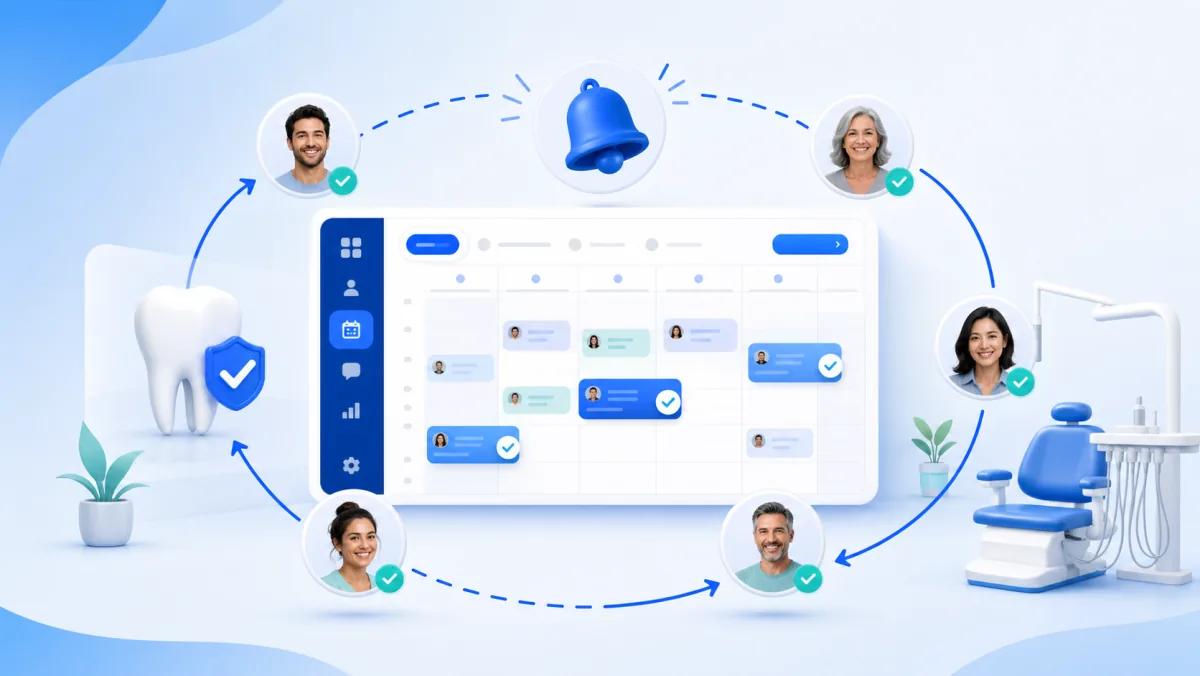
No-shows are a dental clinic's quietest cost, and fixing them doesn't take a single new patient. A calendar that looks full ends up with empty chairs when patients don't come. That is revenue lost outright. A CRM with automatic reminders closes the gap by getting more value from the patients you already have.
Short answer
The fastest way to cut no-shows takes three steps. Send an automatic reminder before the appointment, put a confirm/cancel button inside the message, and send a rebooking message the same day to any patient who didn't come. Once these three steps run in the CRM, the clinic earns more without attracting a single new patient. The second source of revenue is the patients you already have. Reminders for the six-month check-up and follow-up on unfinished treatment bring in appointments at zero acquisition cost.
What do no-shows really cost?
A no-show is more than an empty chair that day. It means lost treatment revenue, a slot another patient could have taken, and wasted staff time. Most clinics don't even measure their no-show rate. Yet cutting it by a few points shows up directly in monthly revenue.
How much do automatic reminders reduce no-shows?
The fastest win is an automatic reminder before the appointment by SMS, Telegram or WhatsApp. A short, polite reminder 24 hours and 2 hours ahead noticeably reduces no-shows. With a confirm/cancel option, a freed slot can go to another patient, so the chair doesn't sit empty.
Reminder channels and the role of each
| Channel | Role in the sequence | Note |
|---|---|---|
| SMS / message | Main reminder channel | Short text with a “Yes / Reschedule” button |
| Supporting channel | For details, if the patient uses email | |
| Phone call | Only for patients who didn't reply to the message | Costly in staff time |
The average no-show rate in dentistry is 15%, and some clinics reach 30%. An automatic reminder is more reliable than a manual one because it reaches every patient, even on the busiest day. Telegram is the most widely used platform in Uzbekistan, which makes it the natural channel for reminders. (Source: 2026 dental marketing benchmarks, average no-show rate)
This table answers one question. Which channel should send the reminder? Calling takes the most front-desk time. A written reminder with a confirm button lets the patient read it and confirm when it suits them. The right setup is a written channel by default and a call only for patients who didn't reply.
How do you track a patient from lead to treatment?
The CRM's second job is making sure no lead gets lost. Every lead from an ad or a call is logged, along with what they asked, whether they booked and whether they started treatment. Patients who didn't answer or said “I'll think about it” get a planned call back. This follow-up recovers much of the revenue most clinics lose.
How do you build repeat visits and loyalty?
An existing patient costs far less than a new one. Six-month check-up reminders, tracking unfinished treatment and regular contact keep patients with the clinic. A satisfied patient comes back and refers others. That makes them your cheapest source of patients.
Which CRM should you choose?
The right CRM fits the clinic's size and patient flow. What works is the system people use, not the expensive one. The essentials are appointment tracking, automatic reminders, lead logging and reporting. After rollout, what matters is that the team actually uses it, not the brand of the tool.
Which fields should the CRM hold?
You don't need a complex system. You need the right fields. The eight fields below cover everything a dental clinic needs.
| Field | Why it matters | When it's filled in |
|---|---|---|
| Source (Ads / maps / Instagram / referral) | Shows which channel brings in business | At first contact |
| Service of interest | Routing to the right dentist + price expectations | At first contact |
| Date and time of first contact | Measuring response time | Automatically |
| Status (new / called / booked / came in / in treatment) | Shows where the funnel leaks | At every step |
| Appointment date | Triggers the reminder | When booking |
| Next step + date | Keeps follow-ups from being forgotten | At every contact |
| Treatment value | Calculating channel profitability | When treatment starts |
| Note | Patient's concerns, family, budget | Any time |
Once these eight fields are kept, you can finally answer “which channel brought in how much money?” In most clinics that question goes unanswered.
How do you set up a reminder sequence?
A reminder isn't one message. It's a short sequence of three touches.
24 hours before: a message asking for confirmation
Don't just write “you have an appointment.” Ask for confirmation, for example “Your appointment is tomorrow at 15:00. Is that still good? Yes / Reschedule.” Confirmation locks in the visit and frees the slot early if the patient can't come.
2 hours before: a short reminder
Send the address and any preparation notes, such as coming on an empty stomach or skipping medication X. This message prevents late arrivals rather than forgetting.
Same day, if the patient didn't come: rebooking
Send a short message that doesn't blame the patient, such as “We were expecting you today. Shall we find another time that suits you?” This one message brings back a large share of appointments that seemed lost.
The channel matters too. A written message with a confirm button is seen when the patient has a moment, while a call demands an answer right now. Telegram is the most widely used platform in Uzbekistan, so this sequence naturally runs on Telegram.
Comparing reminder channels
| Channel | Cost per send | Note |
|---|---|---|
| SMS | Operator rate per message | Backup if there's no reply |
| Telegram | No separate charge | The most widely used platform in Uzbekistan |
| Depends on the mailing service | Supporting channel | |
| Phone call | Front-desk time | Costly in staff time |
Use the second table when you discuss channel costs. Telegram has no per-message charge, while the operator bills every SMS. The practical rule is to record each patient's preferred channel in the CRM at registration. Send the reminder there first, and repeat it by SMS if there's no reply.
How do you calculate the cost of no-shows?
The math is simple, but almost no one does it. Monthly appointments × no-show rate × average bill = lost revenue.
Here is an illustrative scenario, not a measured result. A clinic has 200 appointments a month, a 15% no-show rate and an average bill of $200. That gives 200 × 0.15 = 30 missed appointments × $200 = $6,000 lost per month. If automatic reminders halve the rate, the gain is $3,000 per month, with no new patients at all.
(The 15% no-show rate comes from 2026 dental marketing benchmarks. The appointment count and average bill are assumptions, so plug in your clinic's own figures.)
How does a repeat-patient program work?
Dentistry is a repeat service by nature, with check-ups, hygiene visits and unfinished treatment. But repeat visits don't happen on their own. Someone has to prompt them.
Six-month check-up reminder
A short message goes out automatically 6 months after the last visit. In many clinics this single automation is among the most profitable, because the patient is already satisfied and the acquisition cost is zero.
Tracking unfinished treatment
Patients who stopped partway through a treatment plan go on a separate list and get planned calls. This group is far more profitable than hunting for new patients.
Asking for referrals
When treatment ends and satisfaction peaks, ask for both a review and a referral. Referred patients convert to an appointment at 60–80%, well above patients who come from ads (35–50%).
(Source: 2026 dental marketing benchmarks, appointment conversion from referrals and from ads)
Why do patients miss appointments?
Answer this question before you build the reminder sequence, because forgetting isn't always the reason. Clinics treat every no-show as one group. But different causes need different fixes, and the wrong fix costs both budget and three months.
The patient who forgot
A patient who booked weeks ago and then had work or a trip come up really does forget. This is the largest share of no-shows, and automation covers it fully. Two messages, a confirmation request 24 hours ahead and the address 2 hours ahead, bring back almost all of this group.
The patient who hesitates
The second group doesn't forget. They don't want to come, because of fear of the procedure, an unclear price or the thought that the pain has gone. A third reminder won't help them. They need a short call and a clear answer to “how long will it take and how much will it cost?”
This group is easy to spot in the CRM. They received the reminder but didn't confirm. A same-day call saves the appointment and frees the slot early if they still won't come.
The patient the message never reached
The third group never sees the message. The number was entered wrong, the patient doesn't use that channel, or the message landed in a folder nobody checks. In clinics confident that their reminders work, this silent loss goes unnoticed the longest. The fix is to verify the number at registration and run a report of undelivered messages.
A practical way to separate the three causes is a mandatory reason field whenever the status is set to “didn't come.” After a month this field tells you where the budget should go. If forgetting dominates, invest in automation. If hesitation dominates, train the front desk to handle those conversations. If delivery fails, fix the booking form.
How do you budget and plan the first 90 days of a CRM rollout?
A CRM rollout isn't a software purchase. It's a ninety-day project to build a habit. Most of the budget goes not to the licence but to setup and to the time it takes the team to actually use the system. That's why the plan runs month by month.
| Period | What we do | What we measure |
|---|---|---|
| 0–30 days | Define the eight fields, migrate the current patient base, set up the 24-hour and 2-hour reminder sequence | Share of appointments the reminder reached |
| 30–60 days | Same-day rebooking message for no-shows, calls to patients who didn't confirm, mandatory source field | No-show rate compared with the first month |
| 60–90 days | Six-month check-up reminder, unfinished-treatment list, revenue-by-channel report | Number of repeat appointments and revenue per channel |
The metric column turns the table from a task list into a management tool. At the end of each period, check one number. If it hasn't improved, don't move on to the next period. Jumping ahead to month-three tasks in month one is the most common reason a rollout fizzles out.
Budget lines
There are three budget lines: software subscription, setup and integration work, and messaging costs. The first two are one-off and predictable. The third depends on the channel. The operator bills SMS per message, while sending via Telegram adds no extra charge.
The simplest way to defend the budget is to write down the loss. In the example above, 200 appointments a month, a 15% no-show rate and a $200 average bill leave a $6,000 hole every month. If the whole rollout costs less than part of one month's hole, there's nothing left to debate.
Who does what
You can outsource setup and automation, but filling in the fields is the front desk's job, and it can't be handed off. If that line isn't agreed in writing, records start going blank by week three. Software doesn't kill a CRM. Fields nobody owns do.
By day ninety you should have two things: a no-show rate measured the same way every time and a table of revenue by channel. To compare your results with the market, use the data in Uzbekistan Digital Marketing 2026: Tashkent Market Data.
What mistakes do clinics make when rolling out a CRM?
Choosing a system that's too complex
A CRM the team doesn't use is no CRM at all. A simple system that actually gets filled in is worth more than an advanced one that sits empty.
Leaving the source field empty
Without the source you can't tell which channel makes money, and the budget gets spent blind.
Using the CRM only as a calendar
A CRM isn't a calendar. Its main value is tracking enquiries that haven't turned into appointments yet.
Sending reminders by hand
Manual reminders are the first thing to slip on busy days. Without automation the system fades within three weeks.
Rollout checklist
Check your readiness against this list. If even one item is still open, the clinic slides back to its old habits within a few weeks.
- Does a confirmation request go out automatically 24 hours before each appointment?
- Does the short reminder 2 hours before include the address and preparation notes?
- Does a patient who didn't come get a rebooking message the same day?
- Is each patient's preferred channel (Telegram/SMS) recorded in the CRM?
- Is the source field mandatory, or can a blank record be created?
- Is the reason field filled in when the status is “didn't come”?
- Is unfinished treatment tracked on a separate list?
- Does the six-month check-up reminder trigger automatically?
- Is the no-show rate measured the same way every month?
Real cases
Our Client Results in This Area
Meta Ads and Google Ads management for an Uzbek container terminal and warehousing operator. Work has just begun.
- Status
- Just started
- Scope
- Meta Ads + Google Ads
- Facilities
- Angren terminal + Andijan warehouse
Digital marketing for a Tashkent-based IVF and women's health center
- Leads · on half the budget
- Increased
- Scope
- Website, SEO/GEO, social ads, CRM, brand consulting
Google Ads management for Turkey's sole authorized representative for West Africa cargo tracking certificates
- Target Markets
- Turkey, Europe, Americas
- Sector
- B2B Logistics
- Campaign Type
- Google Ads
Related reading
- How to Attract Patients to a Dental Clinic: Digital Methods in Tashkent and Uzbekistan
- Dental Clinic Marketing Strategy: Step-by-Step Plan from Audit to Measurement
- Dental Clinic Website: How to Turn Visitors into Appointments
How 101digital sets this up
We build automatic reminders, lead tracking and a loyalty flow into the clinic's system, then measure and reduce no-shows. The goal is to get the most value from the patients you already have. → CRM integration
The most effective way is an automatic reminder before the appointment, 24 hours and 2 hours ahead, by SMS, Telegram or WhatsApp. With a confirm/cancel option, a freed slot goes to another patient.
No. Even a small clinic gains from lead tracking and reminders, because they raise revenue without new patients. Even a simple system beats manual records.
Because nobody logs them or follows them up. A patient who said “I'll think about it” or never replied is forgotten without a planned call. A CRM protects revenue with systematic follow-up.
An existing patient costs far less than a new one. Check-up reminders and regular contact keep them with the clinic. A satisfied patient comes back and refers others, which makes them the cheapest source.
One that fits the clinic's patient flow and that the team actually uses. The essentials are appointment tracking, automatic reminders, lead logging and reporting. Use matters more than the brand.