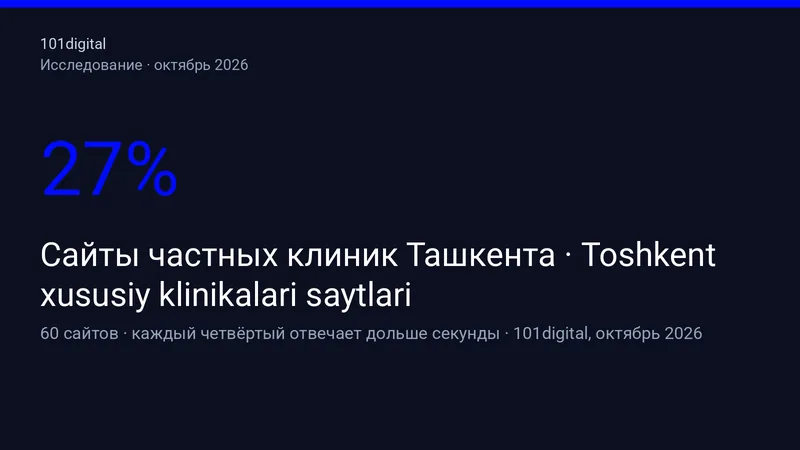
We checked 60 private medical centre websites in Tashkent against 30 measurable criteria. The sample covers multidisciplinary clinics and hospitals, laboratories and diagnostic centres, and clinics for IVF, ophthalmology, cardiology, paediatrics and other specialties. Dental and aesthetic clinics are not part of this study. On the Uzbek language (57% of sites) and on contact channels, private medicine beats every other sector we studied. On speed, it comes dead last. One site in four takes more than a second to respond. The median homepage is half as large again as a dental clinic's. 27% of sites have clinic markup, and 35% run no analytics at all. Only 10 sites out of 60 meet all five basic requirements. Below you'll find every figure, the method and 4 key steps for clinic managers.
Data collected on 17–18 October 2026. A 101digital study, Tashkent. We looked only at public pages and do not name the clinics.
Key figures
- 57% of sites have an Uzbek version. No other sector does better. Yet 90% of sites open in Russian by default. Of the 34 sites with an Uzbek version, 29 hide it behind a language switcher.
- 100% of sites run on HTTPS, 98% are mobile-friendly and 73% have a sitemap.
- 27% of sites have clinic markup (
MedicalClinic,Hospital,LocalBusiness), and 45% have markup of any kind. - 27% of sites take longer than 1 second to respond, and 12% longer than 2 seconds. The median HTML size is 145 KB.
- 65% of sites have analytics installed. The other 35% have no tracking code at all.
- 92% of sites have a tap-to-call phone number, 80% have a booking call to action and 67% link to Telegram. 53% offer phone, Telegram and a booking form together. That is the best result of any sector.
- Only 38% mention prices or a price list. Dental clinics (56%) and auto businesses (66%) do better.
- 53% of images have no alt text. On 23% of sites, the footer still shows 2024 or an earlier year.
- Only 10 sites out of 60 (17%) meet all 5 basic requirements (HTTPS, mobile version, clinic markup, sitemap, Uzbek version).
What we checked and how
We built the list of clinics on 17–18 October 2026 from public sources. We used search queries in Russian, Uzbek and English, the top.uz, yellowpages.uz, goldenpages.uz and med24.uz directories, and industry lists. That gave us 138 domains. We excluded 77 of them. About 40 domains no longer work but are still listed in directories. Another 7 belong to state institutions. We also dropped aesthetic and cosmetology clinics, sanatoriums, clinics outside Tashkent and domains hijacked for spam and casinos. Finally, 8 multidisciplinary centres were already part of our study of dental clinic websites.
One more site failed the check because its SSL certificate had expired. The final sample had 60 working sites. That includes 28 multidisciplinary centres and hospitals, 14 laboratories and diagnostic centres, 4 IVF and reproductive clinics and 14 specialist clinics (ophthalmology, cardiology, paediatrics, dermatology, neurology, urology, orthopaedics, allergology, vaccination, oncology). For each site, a script downloaded the homepage, robots.txt and sitemap.xml and recorded the HTTP headers and response time. We did not log into accounts or open hidden pages. A criterion counted as met only if the homepage code confirmed it. Take the "Uzbek version". It counted if the homepage opens in Uzbek or links to an Uzbek version. That link can be an hreflang tag, a URL like /uz/ or a language switcher.
57% have an Uzbek version, but few visitors ever see it
| Site languages | Sites | Share |
|---|---|---|
| Russian only | 25 | 42% |
| Russian + Uzbek | 19 | 32% |
| Russian + Uzbek + English | 13 | 22% |
| Uzbek only | 2 | 3% |
| Not determined | 1 | 2% |
| Source: 101digital study, October 2026. Based on homepage language, hreflang tags, language-version URLs and the language switcher. | ||
No sector offers an Uzbek version more often than medicine. 57% of sites have one. Compare that with 46% of dental clinics and 33% of logistics firms. Laboratories (71%) and specialist clinics (67%) lead multidisciplinary centres (43%) here. But patients barely notice. Of the 60 sites, 54 open in Russian. Only 5 greet visitors in Uzbek straight away. 22% have an English version. So medical tourism, for all the talk about it, barely shows up on these sites. 33% have hreflang tags set up.
| Segment | Sites | Uzbek version | Clinic markup | Has analytics | Telegram |
|---|---|---|---|---|---|
| Multidisciplinary centres and hospitals | 28 | 43% | 21% | 68% | 64% |
| Laboratories and diagnostics | 14 | 71% | 29% | 64% | 57% |
| Specialist clinics (incl. IVF) | 18 | 67% | 33% | 61% | 78% |
| Source: 101digital study, October 2026. | |||||
A solid technical base, except for HSTS
| Check | Passed | Share |
|---|---|---|
| Site opens over HTTPS | 60 | 100% |
| HTTP redirects to HTTPS | 51 | 85% |
| Mobile layout (meta viewport) | 59 | 98% |
| robots.txt file | 52 | 87% |
| sitemap.xml | 44 | 73% |
| Canonical URL | 43 | 72% |
| Open Graph (Telegram preview) | 43 | 72% |
| HSTS | 13 | 22% |
| Response compression | 52 | 87% |
| Source: 101digital study, October 2026. | ||
On basic technical hygiene, private medicine trails only the auto business. Every site runs on HTTPS and almost all of them work on a phone. Three quarters have a sitemap and a canonical URL. There is one weak spot. Only 22% of sites have HSTS enabled. Yet on a clinic site, patients type their name and phone number into a booking form. Blocking insecure connections should be standard here. 5 sites have SSL certificates that expire within the next 30 days.
27% have clinic markup for Google and AI search
Structured data tells a search engine that it is looking at a medical organisation. It lists the address, phone number, opening hours and specialty. Google uses this data for business listings. AI answers rely on it to match a website to a specific clinic (Google's documentation on business markup).
- 27 sites (45%) have markup of any kind.
- 16 sites (27%) have markup that identifies a clinic. The types found are
MedicalClinic(13 sites),Hospital(1),LocalBusiness(4) andMedicalBusiness(1). Some sites use several types at once. - We found no markup for doctors (
Physician) or services (MedicalProcedure,Service) on any homepage.
Specialist clinics do better on markup (33%) and multidisciplinary centres worse (21%). For medicine, that is a costly gap. Searches like "cardiologist Tashkent" or "blood test near me" are answered by local results and maps. That is where markup and a Google Business Profile work together.
Titles and descriptions beat other sectors
| Check | Sites | Share |
|---|---|---|
| Title shorter than 30 characters | 9 | 15% |
| Title longer than 60 characters | 17 | 28% |
| "Tashkent" / "Toshkent" in the title | 40 | 67% |
| No meta description | 6 | 10% |
| No H1 heading | 13 | 22% |
| More than one H1 | 10 | 17% |
| Source: 101digital study, October 2026. | ||
Only 10% of sites lack a meta description. That is the best result of any sector. 67% name the city in the title. The real problem lies elsewhere. 17% of sites have several H1 headings on the homepage. Usually each banner slide is marked up as an H1, and Google can't tell what the page is about.
The slowest sector we studied
- The median server response time is 0.65 s and the average is 1.33 s.
- Only 17% of sites respond in under 0.5 s. 27% take longer than 1 second, and 12% longer than 2 seconds.
- The median homepage HTML weighs 145 KB. That is half as large again as at dental clinics (97 KB) and twice the size at logistics firms (70 KB). On 7 sites the HTML tops 500 KB.
- 33% of sites use WebP/AVIF and 40% lazy-load their images.
Heavy homepages are to blame. They carry sliders full of doctors' photos, lists of dozens of services, and booking and chat widgets. Much of it runs on WordPress with multi-layered themes. WordPress powers 28% of the sites and Tilda 15%. We measured response times from Europe. That still gives a fair comparison between sites. Google considers a response under 0.8 s good (web.dev, Time to First Byte). Patients often look for a clinic on their phone, in a taxi or in a queue. Every extra second can send them to a competitor.
How clinics take bookings
| Element | Sites | Share |
|---|---|---|
| Phone number in +998 format | 59 | 98% |
| Tap-to-call phone (tel:) | 55 | 92% |
| "Book an appointment" call to action ("записаться" / "qabulga yozilish") | 48 | 80% |
| Booking form | 44 | 73% |
| Telegram link | 40 | 67% |
| Instagram link | 39 | 65% |
| Prices or price list mentioned | 23 | 38% |
| Clinic map | 11 | 18% |
| 6 | 10% | |
| Phone + Telegram + form together | 32 | 53% |
| No contact channel on the homepage | 2 | 3% |
| Source: 101digital study, October 2026. | ||
On conversion elements, private medicine leads the field. 92% of sites have a tap-to-call number, and 53% offer phone, Telegram and a form together. There are two weak spots. The first is prices. Only 38% of sites show them, even though the cost of a consultation or a test is the first thing patients ask. The second is the map (18%). A clinic with five branches doesn't show on its homepage where they are.
35% of clinics measure nothing
- 53% of sites use Google Analytics.
- 43% use Yandex Metrica.
- 17% have the Meta pixel. That is more than in other sectors. Clinics advertise more actively on Instagram.
- 21 sites (35%) have no tracking code at all.
Say you spend money on Instagram and Google Ads but don't track bookings from your site. Then you can't tell which channel brings in patients and which one just burns cash.
Images and freshness
We counted 1,938 images on the 60 homepages. They show doctors, equipment and treatment rooms. 53% of them have no alt text. On 7 sites, not a single image has alt text. The footer on 14 sites (23%) still shows 2024 or an earlier year. In medicine, that is a matter of trust. A patient who sees "© 2023" starts to wonder whether the clinic is still open and whether its prices and doctors are current.
What sets the top 10 sites out of 60 apart
Five requirements don't depend on budget. They are HTTPS, a mobile layout, clinic markup, a sitemap and an Uzbek version. Only 10 sites out of 60 (17%) meet all five. That is twice the share in logistics, but still less than a fifth of the market. Private medicine in Tashkent has mastered the "shop window", meaning contacts, booking and mobile. It lags on what makes a site visible in search. That means speed, markup, Uzbek by default and prices.
4 key steps for clinic managers
- Test your homepage speed on a phone (PageSpeed Insights). If the server takes more than a second to respond, trim the slider, remove extra widgets and turn on caching. This is the most common problem in the sector.
- Add
MedicalClinicmarkup (orHospital,MedicalBusiness). Include the addresses of all branches, a +998 phone number, opening hours and a link to your Google listing. Mark up doctors asPhysician. - Show the Uzbek version by default to visitors whose browser is set to Uzbek, and add
hreflang. Right now 29 of the 34 clinics with an Uzbek version hide it. - Publish prices, at least for a consultation and basic tests. 62% of your competitors don't.
Detailed guides for each step: what a clinic website should include, 12 reasons a website gets no leads, how to use Google Search Console.
Limitations of the study
- We checked only the homepage, robots.txt and sitemap.xml. Pages for doctors, services and prices were not analysed.
- Criteria were detected automatically from the HTML code. Sites that load content with scripts may have scored lower than they deserve.
- Response times were measured from Europe.
- The sample includes 60 sites found in public sources. We excluded dental and aesthetic clinics on purpose. Clinics without a website are not covered.
- Data recorded on 17–18 October 2026.
We will share the full methodology with journalists and medical associations on request. If you cite this study, credit it as "101digital study, October 2026" and link to this page.
The 101digital series "Tashkent business websites, 2026": dental clinics, manufacturing, auto business, logistics, jewellery.
According to the 101digital study (October 2026), 57% of 60 private medical centre websites in Tashkent have an Uzbek version. That is the best result of any sector studied. But 90% of the sites open in Russian by default. Only 5 sites greet patients in Uzbek.
45% of sites use markup of any kind. 27% have markup that identifies a clinic (MedicalClinic, Hospital, LocalBusiness). Specialist clinics score higher (33%) and multidisciplinary centres lower (21%).
Private medicine is the slowest sector we studied. The median server response time is 0.65 s. 27% of sites take longer than 1 second to respond, and 12% longer than 2 seconds. The median homepage size is 145 KB.
65% of sites have at least one tracking code. Google Analytics is on 53%, Yandex Metrica on 43% and the Meta pixel on 17%. 35% of clinics (21 out of 60) don't measure traffic at all.
Only 38% of sites mention prices or a price list on the homepage. That is fewer than dental clinics (56%) and auto businesses (66%). 18% show a clinic map.
On 17–18 October 2026, 101digital collected 138 domains of private medical organisations in Tashkent from public sources. We excluded 78 of them. These were dead domains, state institutions, aesthetic clinics and organisations outside Tashkent. A script then checked the homepages of 60 sites against 30 criteria. Dental clinics are covered in a separate study. Clinic names are not published and the data is aggregated.
Sources
- 101digital study "Websites of private medical centres in Tashkent". Data collected on 17–18 October 2026, 60 sites, automated check of public pages, 101digital.uz (this page).
- 101digital study "Tashkent dental clinic websites 2026", used for comparison.
- Google Search Central, Local business structured data.
- web.dev, Time to First Byte (TTFB).
How does your clinic's site compare with these 60?
101digital runs SEO, websites and advertising for clinics and medical centres in Tashkent. We'll check your site against the same 30 criteria for free and show you what to fix first.
Related pages:
Marketing for medical centresSEO services in TashkentFree SEO/GEO audit
Get a website review →