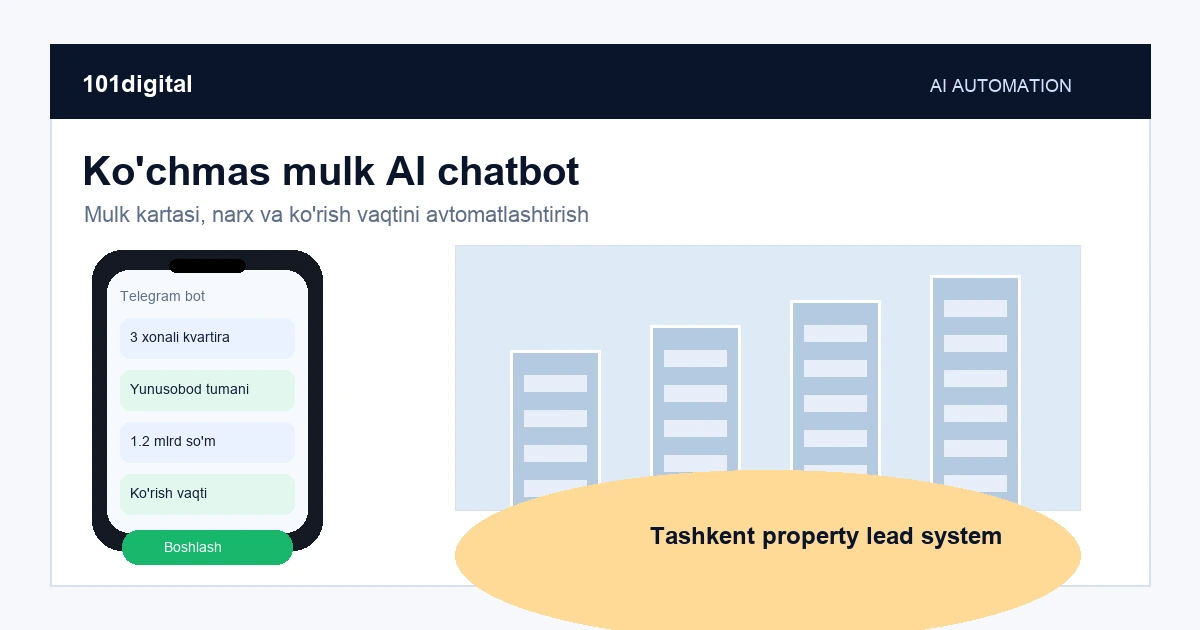
Every day in Tashkent, thousands of people search for properties through Telegram — messaging things like "apartment Yunusobod" or "new development Tashkent price". Real estate agencies using AI chatbots respond to 73% of these inquiries within 90 seconds, capturing leads an average of 4 hours ahead of competitors who rely on manual responses. For international businesses entering Uzbekistan's property market — whether from Europe, the Gulf, or East Asia — this responsiveness gap is even more consequential: buyers searching across multiple time zones expect instant answers. Tashkent's real estate market grew 34% between 2024 and 2026, and the agencies winning market share are not necessarily those with the best listings, but those with the fastest, most intelligent first response. At 101digital, we have deployed AI chatbot solutions for 12+ real estate clients across Uzbekistan, and this guide shares what we have learned: what works, what the numbers actually look like, and how to build a bot that generates real pipeline.
Why Is Tashkent's Real Estate Market Ready for AI Automation?
Tashkent is experiencing one of Central Asia's most dynamic property booms. In 2025, residential property sales increased by 28% year-over-year, with Yunusobod, Mirzo Ulugbek, and Sergeli districts seeing record numbers of new developments. Foreign investment in Uzbek real estate reached approximately $1.2 billion in 2024, with buyers coming from Turkey, Russia, China, South Korea, and the UAE.
This influx of international buyers creates a unique challenge: they operate in different time zones, speak different languages, and conduct research outside of Tashkent business hours. A buyer in Istanbul or Dubai researching property at 10 PM Tashkent time will receive no response from agencies relying entirely on human staff. An AI chatbot closes this gap completely.
Telegram dominates messaging in Uzbekistan with 18+ million monthly active users — more than WhatsApp or any other platform. Real estate channels on Telegram attract hundreds of thousands of followers. For international investors, Telegram offers a familiar, fast interface to research properties and contact agencies without needing a local SIM or bank card.
What Does a Real Estate AI Chatbot Actually Do?
A real estate AI chatbot manages the entire customer journey from first contact to appointment booking — and beyond. Core capabilities include:
- Instant greeting and qualification: The bot asks 3-4 qualifying questions ("Which district? What is your budget? Are you looking to invest or live?") and segments the lead within 60 seconds.
- Portfolio matching: Based on the client's criteria, the bot pulls matching listings from your CRM in real time and sends visual property cards directly in the Telegram chat.
- Appointment scheduling: The bot shows agent availability, collects confirmation, and automatically adds the viewing to Google Calendar.
- Follow-up sequences: Automated messages at 24 hours, 72 hours, and 7 days after a viewing — with additional property suggestions and price drop alerts.
- Multilingual support: Uzbek, Russian, English, and optionally Chinese or Turkish — serving Tashkent's cosmopolitan buyer profile without separate staff for each language.
Telegram Bot vs. Traditional Methods: A Comparison
| Metric | Traditional Approach | AI Telegram Bot |
|---|---|---|
| First response time | 2-8 hours (business hours only) | 5-30 seconds (24/7/365) |
| Daily inquiries handled | 15-25 (human capacity) | Unlimited (parallel processing) |
| Cost per qualified lead | $8-15/lead | $0.80-1.50/lead |
| Weekend and late-night coverage | None or significantly delayed | Full capacity |
| CRM integration | Manual data entry | Automatic, real-time |
| Multilingual support | Requires separate staff | Single bot, 3+ languages |
| Monthly operating cost | $1,500-3,000 (staff) | $150-400 (bot) |
How to Build a Real Estate Bot for the Tashkent Market: Step by Step
Building an effective real estate Telegram bot requires five distinct phases. Agencies that rush to deployment without completing each phase typically end up with a bot that runs but does not convert.
Phase 1 — Customer Segmentation and Conversation Flow Design: The bot's conversation scenarios must reflect how Tashkent property buyers actually make decisions. A Chinese investor evaluating rental yield in Yunusobod and a local family buying their first apartment in Sergeli require completely different conversation flows. Each segment needs a tailored path through the bot.
Phase 2 — Portfolio Integration: The bot connects to your agency's CRM (Bitrix24, AmoCRM, or custom software) via API. When a client writes "2-bedroom, Chilanzar, under $80,000" — the bot pulls live inventory from the database, not a static list.
Phase 3 — Lead Scoring Logic: A scoring system classifies each contact by purchase intent. "Plans to buy within 30 days + budget confirmed" = hot lead → instant agent notification. "Just researching" = nurture sequence.
Phase 4 — Testing and Optimization: In the first 2 weeks, the bot is tested across 50-100 real conversations. Drop-off points are identified — where users stop responding — and the flow is refined before full-scale deployment.
Phase 5 — Traffic Integration: Instagram ads, Google Ads campaigns, and all website CTAs are redirected to the Telegram bot. Without traffic, even a perfect bot sits idle. This step determines how many leads the bot generates.
101digital Case Study: Real Estate Agency in Mirzo Ulugbek District
A real estate agency in Tashkent's Mirzo Ulugbek district engaged 101digital in March 2025. The agency was receiving 80-100 leads per month but converting only 15% into transactions. The core problem: after-hours inquiries went unanswered for hours, and agents were spending too much time qualifying low-intent leads manually.
The solution was a three-language (Uzbek/Russian/English) Telegram bot integrated with Bitrix24 CRM. Google Ads campaigns were restructured to send traffic directly to the bot rather than a landing page. Month-one results: monthly leads increased from 80 to 210, lead-to-transaction conversion rate improved from 15% to 31%, and per-agent productivity doubled. The investment paid back in month three.
The differentiating factor was not the technology — it was the conversation design. The bot was built around how Tashkent buyers actually think: extended family involvement in purchase decisions, sensitivity around down payment amounts, strong preference for developer instalment plans over bank mortgages.
CRM Integration: Why It Makes or Breaks Your Bot
When the bot automatically logs every lead to your CRM, nothing falls through the cracks. Phone number, budget range, district preference, preferred contact time — all captured automatically in a CRM card without any agent action required.
CRM system integration is the most critical component of a real estate bot. Without Bitrix24 or AmoCRM integration, the bot becomes a messaging tool that generates conversations but no trackable pipeline. 101digital treats CRM integration as a mandatory component of every bot deployment, not an optional add-on.
The hot lead notification system is particularly transformative for sales teams. When the bot identifies that a user "plans to decide this week," the relevant agent receives an instant Telegram notification with the full conversation history. The question of "who called about what" becomes a relic of the past.
Which Real Estate Businesses Benefit Most from AI Chatbots?
The ROI from an AI chatbot varies significantly by agency profile. Maximum returns come from agencies that match these criteria:
- Receiving at least 50+ inquiries per month (below this, human management may be more cost-effective)
- Running active paid advertising on Google Ads or social media
- Portfolio of 5+ active listings for meaningful filtering
- Multilingual buyer base (Uzbek + Russian as a minimum; English for international buyers)
Developers selling new residential projects benefit most dramatically. During a project launch period, 200-500 daily inquiries are not unusual — a volume no sales team can handle manually. The bot becomes the first point of contact for every potential buyer, qualifying them before they ever speak to an agent.
2026 Trends: What Is Coming Next for Real Estate AI Bots?
Voice message processing (Voice-to-Text), virtual tour integration, and GPT-powered negotiation assistants are the defining trends of 2026. Several major Tashkent developers are already testing 360° virtual tour integration within Telegram: a user types "show me this apartment" and the virtual tour opens directly in the chat interface without leaving the app.
Predictive analytics is another emerging capability: models trained on historical conversation data that predict which leads will convert within 30 days. Combined with CRM data and paid traffic analytics, these models allow agencies to prioritise outreach with surgical precision rather than working every lead with equal intensity.
Frequently Asked Questions
A basic real estate bot takes 2-3 weeks to develop. A customised bot for the Tashkent market with 101digital typically costs $800-1,500 USD. With CRM integration and multilingual support, the range is $1,500-2,500 USD. Monthly maintenance is approximately $100-200 USD.
Yes. Multilingual bots can be built to automatically detect the language of the user's first message, or to present a language selection menu. For Tashkent's real estate market, Uzbek and Russian are essential; English is highly recommended for international buyer segments.
The bot operates exclusively on real data from your CRM and property database — it cannot generate its own information. A "don't know" scenario is always configured: when the bot cannot answer, it automatically routes the conversation to a live agent. Regular content updates and monthly scenario audits keep error rates minimal.
This depends entirely on your traffic source. A bot with no paid advertising may generate 20-40 organic leads per month. With active Google Ads or Instagram campaigns, this rises to 80-200 leads per month. Average metrics across 101digital's real estate clients: 90 qualified leads per month, 28% lead-to-transaction conversion rate.
Both platforms can be supported. However, Telegram significantly dominates messaging in Uzbekistan. Once the bot infrastructure is built, WhatsApp Business API integration can be added, enabling lead capture from both channels with a single backend system.
Conclusion: Capturing Competitive Advantage in Tashkent's Property Market
In Tashkent's 2026 real estate market, success is determined not only by the quality of your portfolio but by the speed and intelligence of your first response. The agencies consistently outperforming competitors have a common characteristic: they respond first, qualify smartly, and follow up automatically.
An AI Telegram chatbot integrated with your CRM, connected to your advertising campaigns, and designed around how Tashkent buyers actually make decisions is the most powerful tool available for sustainable lead generation. For international businesses entering Uzbekistan's property market, it also serves as your always-on, multilingual representative — present at every moment your human team cannot be.
Free Bot Consultation for Your Real Estate Business
Let us calculate how many qualified leads your agency could generate monthly and how an AI chatbot would integrate with your current portfolio and CRM. We bring experience from 12+ real estate projects across Tashkent and Uzbekistan.
Get Free Consultation →101digital — Tashkent-based digital marketing agency. AI automation, CRM integration, and digital growth solutions for real estate, healthcare, education, and retail sectors in Uzbekistan. Let's discuss your project →