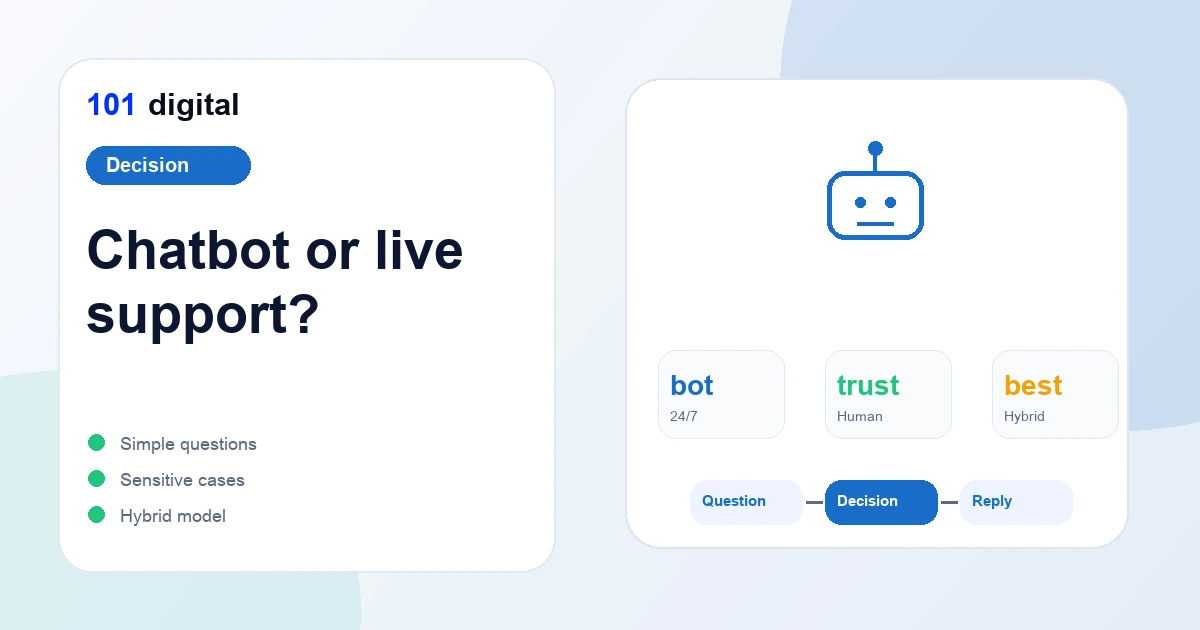
Choosing between a chatbot and live customer support is one of the most consequential decisions a business can make in 2026. The short answer: chatbots win on speed and cost, but live agents win on complex problem-solving and emotional connection — and the smartest businesses in Toshkent are combining both. Whether you run an e-commerce store, a logistics company serving the Fergana Valley, or a SaaS startup targeting Central Asian markets, this guide will help you decide exactly which model fits your needs, your budget, and your customers' expectations.
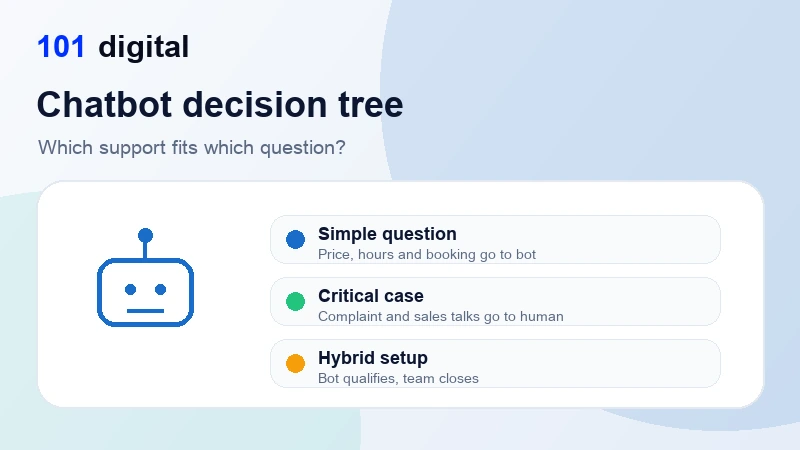
Table of Contents
- What Is the Difference Between Chatbot and Live Support?
- How Do Chatbot and Live Support Costs Compare?
- Which Is Faster and More Satisfying for Customers?
- When Should You Use a Chatbot vs a Live Agent?
- How Are Uzbekistan Businesses Using Chatbots in 2026?
- What Is the Hybrid Support Model and Why Does It Win?
- Frequently Asked Questions
What Is the Difference Between Chatbot and Live Support?
A chatbot is an automated software program that interacts with customers using pre-defined rules, AI language models, or a combination of both. Modern AI chatbots powered by large language models can understand natural language, answer multi-step questions, process orders, and even escalate complex issues to human agents seamlessly.
Live support, by contrast, involves a real human agent who responds to customer inquiries via chat, phone, or email. Live agents bring empathy, contextual judgment, and the ability to handle genuinely novel or sensitive situations that no algorithm can anticipate.
The key distinction is not just technology — it is intent and use case. Chatbots are built for volume, speed, and consistency. Live agents are built for complexity, trust, and relationship-building. Understanding this distinction is the foundation of any sound customer support strategy for businesses across Uzbekistan.
How Do Chatbot and Live Support Costs Compare?
Cost is often the first factor business owners examine. Here is a direct comparison based on 2026 market data for small-to-mid-sized businesses operating in Uzbekistan and the broader CIS region:
| Cost Factor | AI Chatbot | Live Support Agent |
|---|---|---|
| Setup cost | $300-$2,000 (one-time) | $0 setup (hiring cost: $500-$1,500/agent) |
| Monthly operating cost | $50-$300 (SaaS subscription) | $200-$600/agent (salary, Uzbekistan avg.) |
| Cost per resolved ticket | $0.05-$0.50 | $2-$8 |
| Scalability cost | Near-zero (handles 10,000+ chats simultaneously) | Linear (each agent handles 40-60 chats/day) |
| Training cost | Low (update FAQ/knowledge base) | High (onboarding: 2-4 weeks) |
| 24/7 availability cost | Included in base price | Overtime or shift premium for after-hours |
For a Toshkent-based retailer handling 500 daily inquiries, running a live-only support team could cost 10-15x more than deploying an AI chatbot for tier-1 queries. This does not mean live support is wasteful — it means deploying it strategically for high-value interactions delivers the best ROI.
If you are evaluating AI-powered customer support solutions for your business, the total cost of ownership over 12 months almost always favors a hybrid model over pure live support for volume-heavy use cases.
Which Is Faster and More Satisfying for Customers?
Speed and satisfaction pull in opposite directions depending on the query type. Here is what the data shows:
- Response time: Chatbots respond in under 1 second. Live agents average 2-5 minutes in chat, 24 hours in email.
- First-contact resolution (FCR): Chatbots achieve 70-85% FCR for simple queries such as order status, FAQs, and account info. Live agents achieve 90%+ for complex or emotionally sensitive queries.
- Customer satisfaction (CSAT): Chatbots score 3.5-4.0/5.0 on average. Live agents score 4.2-4.7/5.0 — but only when wait time is under 3 minutes. Beyond 5 minutes of waiting, live agent CSAT drops below chatbot scores.
- Abandonment rate: 37% of customers abandon a support session if they wait more than 5 minutes. A chatbot eliminates this entirely for first-response.
The takeaway: customers prefer speed for routine questions and human warmth for difficult ones. A well-configured chatbot handles the former so your live agents can focus exclusively on the latter — giving you the best scores in both categories.
When Should You Use a Chatbot vs a Live Agent?
This is the practical heart of the chatbot vs live support comparison. Use this framework to decide:
Use a chatbot when:
- The query is repetitive and rule-based (order tracking, store hours, return policy, account password reset)
- Volume is high and 24/7 availability is required
- You need to qualify leads before routing to sales (collecting name, email, budget)
- You are running a promotional campaign in Andijon or Namangan and expect a spike in inquiries
- The customer communicates in Uzbek, Russian, or English and you need multilingual support without hiring multilingual agents
Use a live agent when:
- The customer is upset, emotional, or escalating a complaint
- The query involves a high-value transaction such as enterprise sales or large custom orders
- Legal, compliance, or financial sensitivity is involved
- The situation is genuinely novel and the chatbot cannot resolve it
- Building a long-term B2B relationship with a partner in Samarqand or Bukhara
Knowing these boundaries lets you design a chatbot workflow that routes correctly 95% of the time, ensuring live agents are never wasted on tier-1 requests and never absent from tier-3 ones.
How Are Uzbekistan Businesses Using Chatbots in 2026?
Uzbekistan's digital economy has accelerated sharply. As of 2026:
- Internet penetration has crossed 78% nationwide, with Toshkent exceeding 91% (UzStat, 2025).
- Telegram remains the dominant messaging platform with 18+ million active users — making Telegram-based chatbots the primary deployment channel for Uzbek businesses, not website widgets.
- E-commerce GMV in Uzbekistan grew 34% year-over-year in 2025, driving demand for automated order-support at scale.
- Banks like Kapitalbank and Hamkorbank have deployed AI assistants handling 60-70% of tier-1 inquiries without human escalation.
- Toshkent-based delivery startups use chatbots to handle real-time courier status queries, reducing call center load by 40%.
For businesses in Fergana, Namangan, or Andijan entering digital channels for the first time, a Telegram chatbot is often the lowest-friction, highest-reach starting point. Local customers already live in Telegram — you meet them where they are.
Our digital marketing team at 101digital has helped Toshkent-based clients deploy Telegram chatbots that handled 2,000+ daily inquiries within the first month of launch, achieving a 68% self-service resolution rate from day one.
What Is the Hybrid Support Model and Why Does It Win?
The hybrid model combines chatbot automation for tier-1 queries with seamless escalation to live agents for tier-2 and tier-3 issues. In 2026, this is no longer a nice-to-have — it is the industry standard for any business handling more than 100 customer interactions per day.
A well-designed hybrid funnel works like this:
- Greeting and intent detection — Chatbot welcomes the user and identifies query type via NLP
- Tier-1 resolution — Chatbot resolves 60-80% of queries autonomously (FAQs, order status, basic troubleshooting)
- Smart escalation — Chatbot detects frustration signals or complexity and hands off to a live agent with full conversation context
- Live agent resolution — Agent sees the entire prior conversation, skips re-qualification, and resolves the issue faster
- Post-chat survey — Automated CSAT collection regardless of resolution path
Businesses implementing this model in Uzbekistan report 35-50% reduction in support costs while simultaneously improving CSAT scores — because live agents, no longer buried in repetitive queries, give their full attention to the customers who need it most.
The hybrid model is also the foundation of AI transformation projects we execute at 101digital, integrating chatbot platforms with CRM systems, Telegram bots, and live agent dashboards into a single unified support stack.
Frequently Asked Questions
No — and in 2026, the goal is not replacement but optimization. Chatbots excel at handling high-volume, repetitive tier-1 queries with sub-second response times. Live agents are irreplaceable for complex, emotional, or high-value interactions. The winning strategy is a hybrid model where chatbots handle 60-80% of volume, freeing live agents to focus on conversations that actually require human judgment and empathy.
For a small business in Toshkent or Samarqand, a basic AI chatbot (Telegram-based, FAQ-driven) typically costs $300-$800 to set up and $50-$150 per month to operate. A custom AI chatbot with CRM integration and multilingual support (Uzbek, Russian, English) ranges from $1,500-$5,000 setup with $100-$300/month in operating costs. This is still 5-10x cheaper than hiring even a single full-time support agent when accounting for salary, taxes, and training.
According to 2025 Forrester data, live chat with a human agent scores the highest CSAT (4.5/5.0) when response time is under 2 minutes. However, AI chatbots score higher than phone support (3.5 vs 3.3) due to speed and availability. Customer satisfaction is more strongly correlated with resolution speed and quality than with the channel itself — a fast, accurate chatbot outperforms a slow, undertrained live agent every time.
For Uzbekistan businesses, Telegram Bot API remains the dominant deployment platform given Telegram's 18M+ user base. For web-based chatbots, Tidio, Intercom, and custom GPT-4o integrations are popular. For businesses needing Uzbek-language NLP, custom-trained models on local datasets outperform generic English-first platforms. 101digital builds custom Telegram and web chatbots tailored to Uzbek, Russian, and English-speaking audiences with local payment gateway integrations (Payme, Click).
Ask three questions: (1) What percentage of your inquiries are repetitive and answerable from a knowledge base? If above 50%, a chatbot will deliver immediate ROI. (2) What are your peak hours? If inquiries spike outside business hours, a chatbot is essential. (3) What is your average query value? If most queries involve high-stakes decisions or unhappy customers, lead with live support and use chatbots for qualification only. Most Toshkent businesses with 50+ daily inquiries benefit from deploying both in a hybrid model.
Final Verdict: Chatbot vs Live Support in 2026
There is no universal winner in the chatbot vs live support debate — but there is a universal best practice: deploy both, intelligently. Chatbots handle volume, speed, and 24/7 availability. Live agents handle complexity, empathy, and relationship value. Together, they form a support system that is cheaper to run, faster to respond, and more satisfying for customers than either approach alone.
For businesses in Toshkent, Samarqand, Bukhara, Namangan, Andijan, and Fergana entering or scaling their digital customer service operations in 2026, the hybrid model is not a luxury — it is the competitive baseline. Your competitors are already automating tier-1 support. The question is whether your live agents are being used for what they are uniquely good at.
If you are ready to audit your current support setup and design an AI-powered hybrid model tailored to your business and market, our team at 101digital is here to help.