Competition in Tashkent's restaurant sector intensifies every year. Tashkent restaurants using digital marketing effectively attract 40% more customers than competitors. Google Maps, Instagram, Telegram, and Yandex Maps — these four channels dominate the Uzbekistan restaurant market in 2026.
Google Maps Optimization
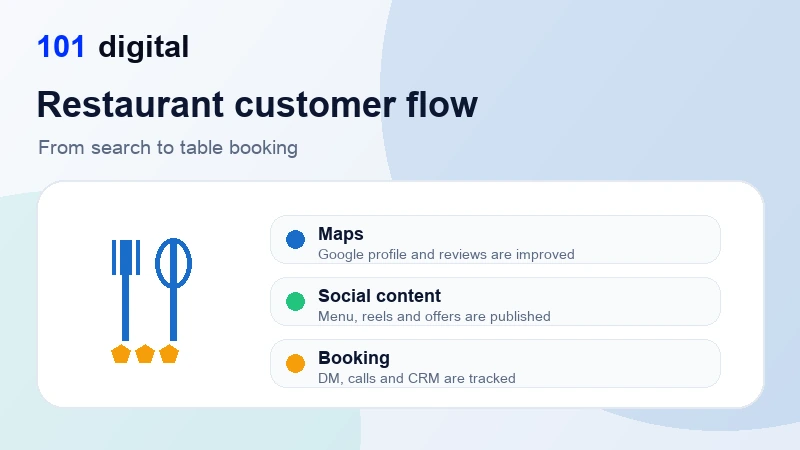
Google Business Profile is the most critical digital asset for Tashkent restaurants. To appear in "restaurant in Tashkent" or "restaurant near me" searches, your profile must be complete and active.
Google Maps optimization steps: Fill all fields (hours, phone, website, menu link), upload photos (minimum 20 professional shots), respond to all reviews within 24 hours, keep Q&A active, and publish Google Posts regularly.
Tashkent restaurants with 150+ reviews get 3.5x more views on Google. 101digital's local SEO services will boost your rankings.
Instagram Food Photography and Content
| Content Type | Engagement Rate | Best Time |
|---|---|---|
| Food close-up photo | 8.2% | 11:30-13:00 |
| Kitchen behind-scenes video | 12.4% | 18:00-20:00 |
| Customer review + photo | 9.7% | 19:00-21:00 |
| Daily menu Reels | 15.1% | 10:00-12:00 |
| Special occasion content | 18.3% | Event day |
Telegram Customer Notifications and Automation
Telegram usage rate in Uzbekistan is 87% — among the highest in the world. Via Telegram bot: automatic reservation reminders, daily menu shares, special offers, and birthday messages can all be automated.
Successful Telegram bot scenarios: "Your reservation is tomorrow, do you confirm?" auto-message, weekly special menu notification, loyalty points balance alert. 101digital's Telegram bot service increases customer loyalty.
A Tashkent restaurant using a Telegram bot reduced no-shows by 45% and increased repeat visit rate by 30%.
Local SEO: Rank #1 on Google
Restaurant local SEO focus: "Tashkent [cuisine type] restaurant" keywords, content mentioning neighborhoods (Chorsu, Yunusobod, Chilonzor), HTML menu page on website (not PDF), mobile-friendliness, page speed.
Don't forget Yandex Maps: Yandex still has strong usage in Uzbekistan, driving 22% of local search traffic. Active profiles on both platforms are essential.
Monthly Digital Marketing Budget Plan
Recommended monthly budget for a small restaurant: Instagram/Facebook ads 40% ($200), Google Ads 25% ($125), SEO and content 20% ($100), Telegram bot management 15% ($75). Total: $500/month.
This budget can attract 120-180 new customers monthly (Tashkent data, 2026). Our performance marketing service optimizes your budget for maximum ROI.
Tashkent Restaurant Success Stories
A Uzbek cuisine restaurant in Yunusobod grew from 800 to 12,000 Instagram followers in 6 months and increased monthly reservations by 180%. A pizza restaurant in Chilonzor ranked #1 in neighborhood search on Google and increased walk-in customers by 65%.
A tourist restaurant in Samarkand tripled foreign guest numbers using a TripAdvisor + Google + Instagram combination. Detailed case studies on our blog.
Instagram + Telegram combination is most effective for Tashkent restaurants. Instagram builds visual brand, Telegram handles loyalty and reservations.
Give QR code cards at payment or exit, send review links via WhatsApp/Telegram. Never fake reviews — Google will suspend your account.
$300-500/month is sufficient to start. Scale as results come in. In Tashkent this budget can attract 100+ new customers monthly.
Professional photos matter but aren't mandatory to start. Good lighting + modern smartphone is enough for the first months.
101digital launches a Telegram bot in 1-2 weeks. Reservation, menu sharing, and loyalty system integration are all included.
When visibility turns into occupied tables
Restaurant marketing is judged in one place: how many tables are taken in the evening. Plenty of venues in Tashkent post beautiful photos and appear on the map, yet the guest still goes elsewhere — the menu was not visible, the reviews had gone stale, or the booking message was answered too late. A hungry person decides quickly, and the restaurant that removes friction in those minutes wins.
So digital work in a restaurant starts with fixing information rather than producing content: opening hours on the map, an up-to-date menu with prices, a phone number and Telegram, and a named person handling bookings. 101digital sets that foundation first and grows demand afterwards.
What to fix before running ads
| Area | What to check | Why it matters |
|---|---|---|
| Map listing | Hours, pin, phone, recent photos | Decides whether you are picked in a nearby search |
| Menu | Priced, current and readable on a phone | Answers the most common question up front |
| Reviews | How recent they are and how often you reply | Builds trust with a first-time guest |
| Bookings | Who replies and how quickly | Turns an empty table into a full one |
Should this stay in-house or go to an agency?
Shooting dishes, posting the dish of the day and replying to reviews can be handled in the rhythm of the kitchen. Agency support becomes useful once the work outgrows a single account: the map listing, delivery platforms, the booking channel and paid ads all run at once, and it stops being obvious which of them brings the guest.
101digital pulls the map listing, the menu and photo set, the booking flow and neighbourhood ads into one system. The first step is not a new campaign; it is walking the guest's path end to end, from the moment they find you to the moment they sit down.
Budget and seasonality
Most of a restaurant's budget goes into good photography and fast replies rather than media. A small ad aimed at nearby blocks is easily wasted by an outdated menu or an unanswered message. Weekdays and weekends, lunch and dinner do not deserve the same budget either. A sensible start is 30 days to fix the map listing, the menu and bookings, then 60-90 days of tuning around peak hours.
FAQ for restaurant owners
The map. A hungry guest nearby usually chooses from the map, and Instagram is the second step that confirms the choice.
Short, personal and without getting defensive. The reply is really written for the next guest reading it.
They bring orders but they do not attach the guest to you. Without your own channel you keep paying commission on every order.
When the map, social media, delivery and ads all run at once but nobody can say which one fills the room.
A practical 30-day plan for a restaurant
The first month is a month of corrections, not campaigns. In week one the map listing is reviewed: opening hours, the pin, the phone number, photos of the entrance and the dining room, and a few current dishes. In week two the menu is made readable on a phone with prices included, and the most common questions are moved to the top. In week three bookings and messages are assigned to one person, so it is clear who replies, during which hours and how fast. In week four a narrow ad opens on the surrounding blocks and guest numbers are read against peak hours.
This is what separates an account that collects reactions from a full dining room. In a restaurant every post should first answer "where should we go tonight" and then move the guest to one step: directions, a booking message or an order.
How 101digital would run it
- Update the map listing, opening hours and photos.
- Make the menu readable on mobile with prices shown.
- Watch reviews and set a routine for replying.
- Bring booking and delivery messages into one queue.
- Tune neighbourhood ads around peak hours and review them monthly.